Coin Errors are mint-made mistakes—accidents that happen during blank (planchet) production, die preparation, striking, or ejection. Because they’re created at the Mint, genuine errors have repeatable diagnostics: the shape of the strike, the way metal flows, the presence (or absence) of rim/collar effects, and the “story” that matches a specific step of the minting process.
The hard truth: most coins people call “errors” are actually post-mint damage (PMD)—dryer coins, heat damage, tools, corrosion, and parking lot abuse. This page teaches you to separate real Coin Errors from look-alikes, understand what’s collectible, and estimate realistic value ranges.
Want verified examples, learning tools, and a community that helps you confirm what you have?
Create your free account: https://richofferrorcoins.com/registration
Understanding Coin Errors (and How They Differ From Varieties)
Coin Errors vs. Varieties (Important)
Collectors often mix these up:
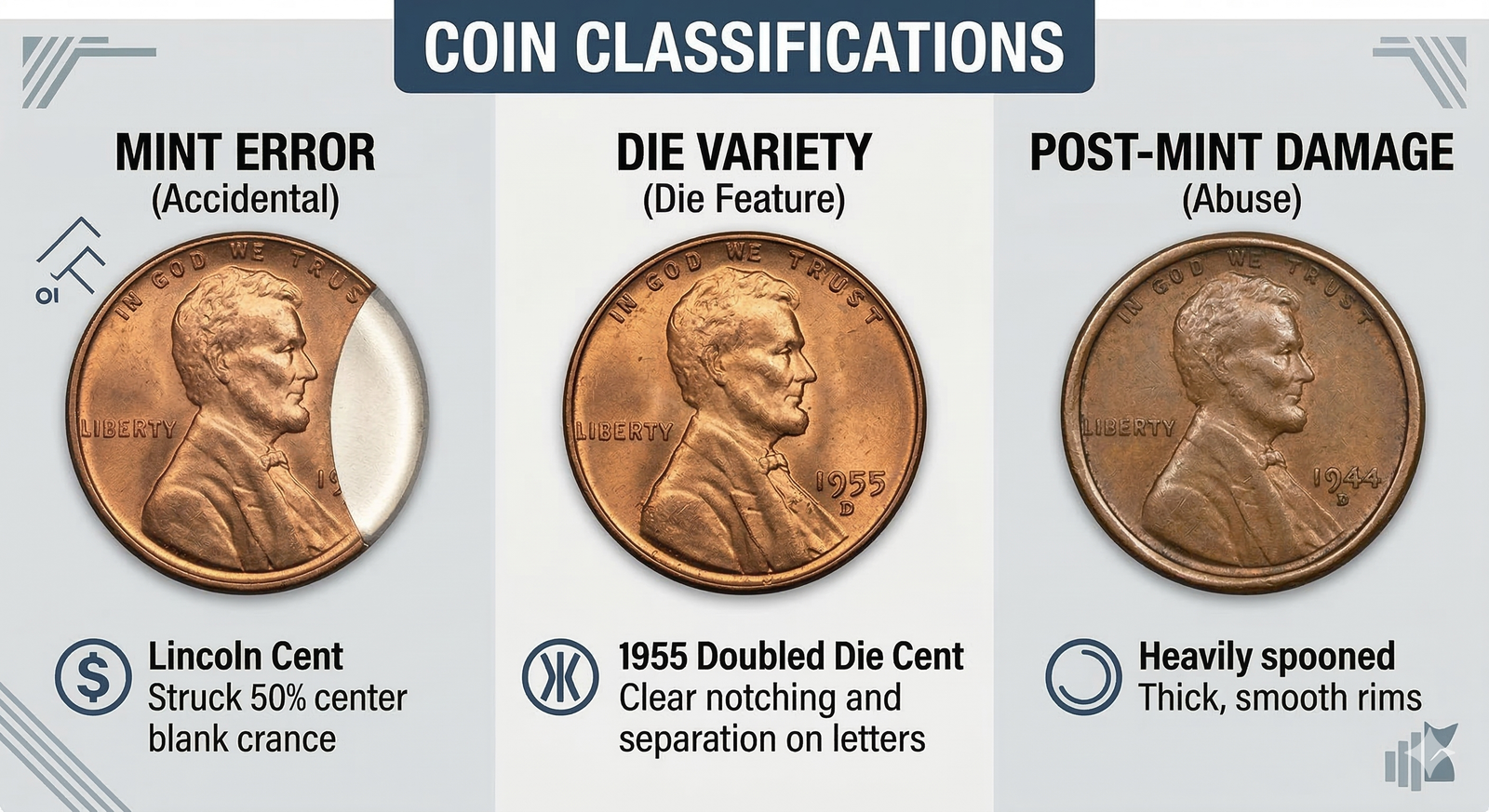
- Coin Errors = accidents in manufacturing (often one-off or low population).
- Examples: off-center strike, broadstrike, cap die, struck-through, wrong planchet.
- Varieties = differences in the dies (repeat on many coins).
- Examples: doubled die, repunched mintmark (older issues), overdates, design varieties.
Both can be valuable, but identification methods differ. A doubled die is not “damage”—it’s a die variety. An off-center strike is a true mint error.
How Coins Are Made (So You Can Identify Errors Fast)
Understanding the stages turns “guessing” into “diagnosing.”
Stage 1: Planchet Production
Metal is rolled to thickness → blanks are punched → blanks are annealed (heated) → cleaned → upset rim formed.
Errors here usually affect:
- shape (clips)
- thickness/weight
- surface/texture (improper anneal)
- metal type (wrong planchet/off-metal)
Stage 2: Die Preparation and Use
Dies are hubbed/created → polished → installed in the press.
Errors here show as:
- doubling from the die (doubled die varieties)
- cracks, chips, cuds, die breaks
- die deterioration and flow lines
Stage 3: Striking and Ejection
Planchet enters collar → struck by dies under pressure → coin is ejected.
Errors here create:
- off-center strikes
- broadstrikes (no collar constraint)
- multiple strikes
- caps, counterbrockages
- struck-through debris
- die adjustment strikes (weak)
Types of Coin Errors (By Category)
Planchet Coin Errors (Before the Strike)
Planchet errors are some of the most misunderstood because damage can mimic them. The key is weight, shape diagnostics, and whether the rim/metal flow makes sense.
Blank Planchet (Unstruck)
A blank planchet is a properly prepared blank that never got struck.
Identification
- No design at all
- May have an upset rim (depending on type)
- Correct weight for the denomination/year
- Normal Mint surface texture (not ground, sanded, or melted)
Realistic value range
- Common modern cents/nickels: $1–$10
- Scarcer denominations/metals or nicer surfaces: $10–$50+
- Silver planchets or unusual issues can be higher, but authentication matters
Common mistakes
- Calling a “slug” or arcade token a blank planchet
- Confusing a damaged coin ground smooth with a true blank
Clipped Planchet
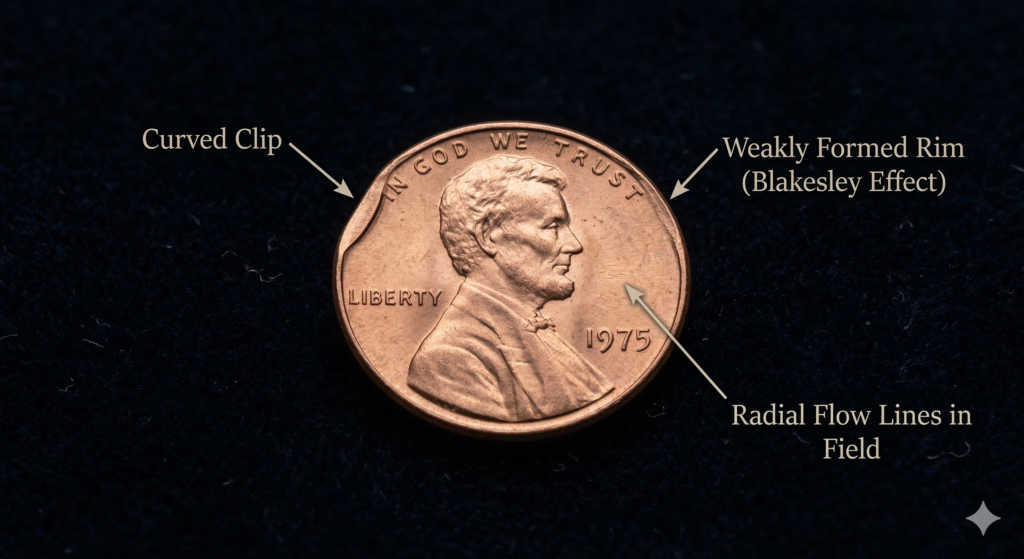
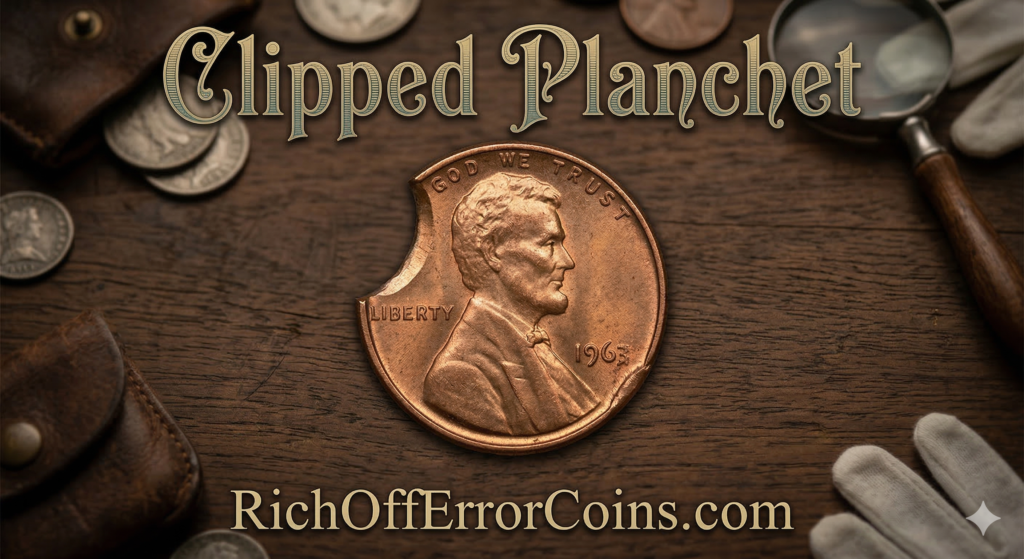
A clip happens when the blanking punch overlaps a previously punched hole or the edge of the metal strip.
Types
- Curved clip (most common)
- Straight clip (less common, often dramatic)
- Ragged clip (tear-like; more suspicious to non-experts)
- Elliptical clip (can occur depending on strip/feeding)
How to identify a real clip (the 3 classic diagnostics)
- Blakesley Effect: weak/flat rim opposite the clip (because metal flow is reduced)
- Flow lines around the clip area that match strike dynamics
- Consistent strike: the design near the clip behaves logically, not random gouges
Realistic value range
- Small curved clips on cents: $3–$25
- Larger clips (clear missing chunk): $20–$150
- Dramatic clips on higher denominations (nickels/quarters/halves): $50–$300+ depending on size and coin type
Common mistakes
- Bites cut with tools (look for sharp edges, no Blakesley effect)
- Damaged rims from counting machines
Wrong Planchet / Off-Metal
A coin struck on a planchet meant for another denomination or composition.
Identification (this is where most people go wrong)
- WEIGHT is king: you must match the expected weight range
- Diameter & thickness should also align
- Color is not enough (environmental toning can fool you)
Examples
- Cent design on a dime planchet (or vice versa) is extremely rare and often faked
- Transitional years (composition changes) are hotspots for confusion and interest
Realistic value range
- Minor off-metal that’s still within similar alloy families: $50–$500
- Dramatic denomination mismatch (authenticated): $500–$10,000+ depending on type
Common mistakes
- Plated coins (post-mint plating)
- Environmental staining
- “Dryer coins” that lose weight and look wrong
Lamination Error (Metal Alloy Defect)
A lamination is when a portion of the metal splits or peels due to impurities or improper bonding.
Identification
- Peel/flap that follows the metal grain
- Exposed underlayer that looks “raw” but not like tool marks
- Often irregular and jagged
Realistic value range
- Minor laminations: $2–$20
- Large, dramatic laminations: $20–$150+
- Higher denominations/older coins can bring more if eye-catching
Common mistakes
- Corrosion that “flakes” the surface (especially zinc cents)
- Delamination from harsh cleaning
Split Planchet (True vs. Fake)
A true split planchet can happen when the planchet separates along layers or internal flaws.
Identification
- Weight often reduced
- Surfaces can appear “woodgrain-like” or porous depending on alloy
- Must match minting logic (one side may show incomplete strike)
Realistic value range
- Often $10–$100 depending on clarity and denomination
Common mistakes
- Heat damage + peeling (especially cents)
- Grinding and prying
Die Errors (From the Die Itself)
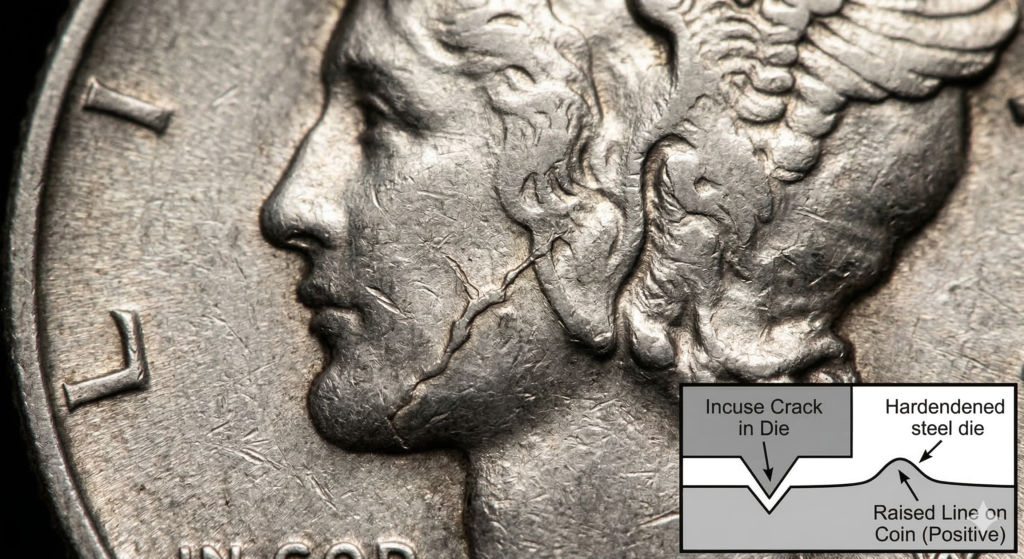
These are typically raised features on the coin because the die is incuse and the coin is the mirror image.
Doubled Die (Technically a Variety, but Often Grouped With Errors)
A doubled die occurs when the die itself receives a doubled impression during hubbing or manufacturing, producing true doubling on every coin struck by that die (until die retirement).
Identification
- Doubling shows as notched serifs, separation lines, and consistent direction
- Appears on specific design elements (letters/date/motto)
- Not flat or shelf-like
Realistic value range
- Minor doubled dies: $5–$75
- Strong examples on popular series: $100–$5,000+ (varies massively by issue)
Common mistakes
- Machine doubling (flat, shelf-like, often reduces design)
- Die deterioration doubling (mushy edges from worn dies)
Die Cracks
A crack in the die creates a raised line on the coin.
Key note (your draft was correct to warn readers):
A die crack is not a crack in the coin—it’s a crack in the die that struck it. The coin shows a raised crack-shaped line.
Identification
- Raised, irregular line often connecting rim to rim or through devices
- Can grow over time (later die states show bigger cracks)
Realistic value range
- Small cracks: $1–$10
- Bigger, dramatic cracks with clear eye appeal: $10–$100+
- Exceptional “spiderweb” cracks or famous issues can exceed that
Common mistakes
- Scratches (scratches are incuse; cracks are raised)
- Die polish lines (thin, parallel raised lines—different look)
Die Chips and Cuds
- Die chip: small piece breaks off die → raised blob on coin
- Cud: die break at the rim → raised unstruck “blob” connected to rim (often dramatic)
Identification
- Raised area, sometimes with loss of design detail
- Cuds are usually at the rim and look “bulgy” or blank-ish
Realistic value range
- Small chips: $1–$20
- Large cuds (dramatic): $20–$300+ depending on size/series
Common mistakes
- Solder blobs, glue, or foreign material stuck on coin
- Damage to rim that displaces metal (will look different under magnification)
Die Clash
Dies strike each other without a planchet in between, transferring portions of one design onto the other die.
Identification
- Ghost-like design elements in the fields
- Often seen near central devices (depends on type)
Realistic value range
- Light clash: $5–$30
- Strong, dramatic clash: $30–$300+
Common mistakes
- Random scratches or roller marks
- Stains that “look like” letters
Striking Errors (During the Strike)
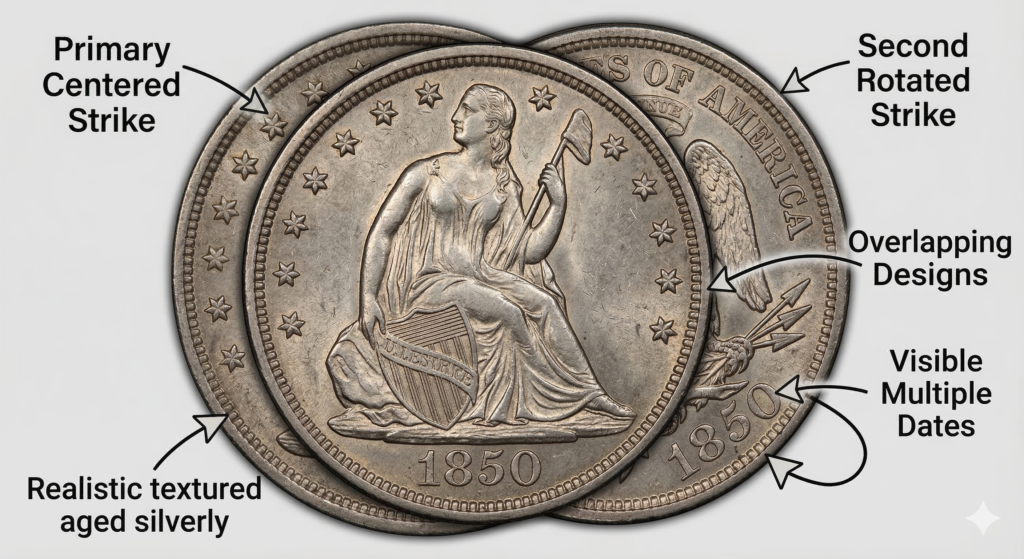
This is where the biggest “wow” errors come from.
Off-Center Strike
Coin is struck when the planchet is not centered in the collar/dies.
Identification
- Part of design missing
- Often shows a crescent of blank planchet
- Value rises when the date/mintmark is visible and the percentage off-center is dramatic
Realistic value range
- Small off-centers (5–10%): $5–$30
- 15–30% with full date: $30–$250
- 50%+ with full date and strong eye appeal: $150–$1,500+ depending on denomination/series
Common mistakes
- Coin partially ground down (no true strike dynamics)
- “Spooned” rims (post-mint)
Broadstrike (No Collar)
A broadstrike happens when the coin is struck outside the collar or without proper collar constraint.
Identification
- Coin is wider than normal
- Often thinner
- Rim looks abnormal; reeding on reeded coins may be weak or missing
Realistic value range
- Modern cents: $10–$75
- Nickels/quarters: $25–$200
- Dramatic broadstrikes on higher denominations: $100–$500+
Common mistakes
- Dryer coins (often show rim damage + distorted designs differently)
- Hammered/flattened coins
Multiple Strikes
Coin struck more than once. Many subtypes exist.
Types
- Multiple strikes in collar (aligned or rotated)
- Multiple strikes out of collar
- Second strike off-center
- Flip-over double strike (coin flips between strikes)
Identification
- Overlapping design elements
- Clear “doubling” that is not a doubled die (it’s a second strike)
- Look for raised secondary impressions with strike characteristics
Realistic value range
- Minor double strikes: $30–$150
- Dramatic multi-strikes: $150–$2,000+ depending on denomination and clarity
Common mistakes
- Hobo/altered coins with added impressions
- Vise jobs (squeezed coins)
Struck Through (Grease, Cloth, Debris)
Foreign material between die and planchet causes missing/soft details or depressed areas.
Identification
- Grease strikes often look like missing letters or weak areas (soft, “filled” look)
- Cloth/debris can leave textured or patterned impressions
Realistic value range
- Light grease strike: $1–$20
- Dramatic, obvious strike-through: $20–$300+
Common mistakes
- Wear (circulation can mimic weak detail)
- Chemical damage
Die Adjustment Strike
Under-pressured strike during setup → weak design but normal planchet.
Identification
- Overall weak strike, often uneven
- No signs of wear as the cause
- Must be consistent with minting, not circulation
Realistic value range
- Often $10–$100 depending on denomination and clarity
Common mistakes
- Worn coins mistaken as adjustment strikes
Caps (Die Cap / Bottle Cap Errors)
A struck coin sticks to a die and repeatedly strikes subsequent planchets, forming a “cap.”
Identification
- Distinctive cupped shape
- Design often distorted and stretched
- Early-stage caps show more design; late-stage are thin and smooth
Realistic value range
- Partial/early cap: $50–$300
- Dramatic caps: $300–$2,500+
Common mistakes
- Heat-warped coins
- Curved coins from physical damage
“Minting Process Errors” (Commonly Used Catch-All)
Many collectors use this phrase to group:
- die adjustment strikes
- struck-through errors
- wrong planchets
- incomplete strikes (when truly mint-related)
It’s better practice to classify by stage (planchet/die/strike), because it helps authentication and valuation.
Identification: How to Tell Real Coin Errors From Damage
The “5-Minute Error Check” (Beginner-Friendly)
- Is the feature raised or incuse?
- Raised often points to die-related; incuse is often damage (but not always).
- Does the rim make sense?
- Collar errors leave recognizable rim/reeding changes.
- Does metal flow match the story?
- Real strikes create predictable distortion patterns.
- Check weight and diameter.
- Especially for wrong planchet/off-metal claims.
- Compare to known examples.
- The fastest way to avoid being fooled.
Basic Tools Every Error Collector Should Own
- Digital scale (0.01g resolution)
- Calipers (0.01mm)
- 10x loupe (or microscope)
- Good lighting (diffuse white light)
- A reference list of standard coin weights by denomination/year range
Value of Coin Errors (Realistic Ranges Only)
Error coin value is driven by five things:
- Error type (major vs minor)
- Severity (how dramatic/clear)
- Demand (popular series like Lincoln cents command stronger markets)
- Coin grade/eye appeal (a clean, attractive error sells better)
- Authentication/attribution (major errors often need grading-service backing)
Quick Value Cheat Sheet (Typical Market Ranges)
- Minor die cracks/chips: $1–$20
- Cuds (large): $20–$300+
- Off-center strikes (date visible): $30–$1,500+
- Broadstrikes: $10–$500+
- Multiple strikes: $30–$2,000+
- Caps: $50–$2,500+
- Wrong planchet/off-metal (verified): $50–$10,000+
These are typical ranges; the exact coin, denomination, and eye appeal matter more than people think.
Common Mistakes (That Cost Collectors Money)
Mistake #1: Calling Machine Doubling a Doubled Die
Machine doubling is common and usually adds little to no value. True doubled dies show notching and separation; machine doubling looks flat/shelf-like.
Mistake #2: Mistaking Dryer Coins for Errors
Dryer coins often show:
- “spooned” rims
- distorted edges
- weird thickness
- smeared details from mechanical abrasion
Mistake #3: Thinking Any Missing Letter = Error
Grease strikes exist, but missing letters can also come from:
- wear
- filled devices from dirt
- damage and polishing
Mistake #4: Assuming “Rare” Without Measurements
If you don’t have weight + diameter, you don’t have an off-metal case—just a guess.
Mistake #5: Cleaning Coins (Kills Premium)
Cleaning can destroy surfaces and make authentication harder. Let the coin be.
Notable “Error Coins” (And Why They Matter)
Some commonly cited examples are varieties, not one-off errors—still collectible, but different category.
- 1955 Doubled Die Lincoln Cent (variety; dramatic doubled die)
- 1937-D Three-Legged Buffalo Nickel (die polishing variety)
- 2004 Wisconsin Extra Leaf Quarter (variety; extra leaf reverse)
Why include these?
Because beginners searching “coin errors” often mean “anything unusual.” This guide helps them learn the correct classification.

FAQ: Coin Errors (Featured Snippet Style)
What are coin errors?
Coin errors are mint-made mistakes created during planchet production, die preparation, striking, or ejection that result in a coin with abnormal features caused by the minting process.
Are coin errors rare?
Some are rare (wrong planchets, dramatic multi-strikes), but many are common (small die cracks, minor grease strikes). Rarity depends on the specific error type and severity.
How can I tell if my coin is a real error?
Check whether features are raised/incuse, examine rim/collar effects, confirm metal flow matches a minting cause, and measure weight/diameter. Compare to verified examples.
What coin errors are worth the most?
High-value errors typically include authenticated wrong planchets/off-metal strikes, dramatic multi-strikes, significant off-center strikes with visible dates, and major cap errors.
Is a die crack a crack in the coin?
No. A die crack is a crack in the die. The coin shows a raised line that is the reverse image of that crack.
Collecting Coin Errors: How to Build a Smart Collection
Start With These (Best Learning-to-Value Ratio)
- Off-center strikes (with date visible)
- Broadstrikes
- Clear struck-through errors
- Larger cuds
Buy Smart
- Stick to reputable sellers
- Prefer coins with clear photos, weight, and measurements
- Consider third-party grading for expensive errors
Keep Records
Track:
- denomination/date/mint
- error type + subtype
- measurements
- purchase source/price
- photos (front/back/edge)
Resources for Error Coin Collectors
- Books
- The Error Coin Encyclopedia (Margolis & Weinberg)
- Cherrypickers’ Guide to Rare Die Varieties (Vol. 1 & 2)
- Websites
- PCGS
- NGC
- Variety Vista
- Community
- Error coin groups, clubs, and forums (especially those that teach diagnostics, not hype)

Join Rich Off Error Coins (Free)
If you’re serious about learning Coin Errors without getting fooled by damage, you’ll progress faster with references, examples, and feedback.
✅ Create your free account here: https://richofferrorcoins.com/registration
Internal Linking Suggestions (RichOffErrorCoins.com)
Use these as supporting pages to build topical authority:
- “Doubled Die vs Machine Doubling: How to Tell the Difference”
- “Off-Center Strike Value Guide”
- “Broadstrike vs Dryer Coin: Don’t Get Fooled”
- “Die Cracks, Cuds, and Die Chips Explained”
- “Wrong Planchet & Off-Metal Errors: Weight Charts and Diagnostics”
- “Best Tools for Error Coin Hunting (Scale, Calipers, Loupe)”
- “Top Error Coins Found in Pocket Change”
AI Image Generation Prompts (For Your Page Images)
Use these to generate clean educational visuals:
- Minting stages infographic
- “A clean educational infographic showing U.S. coin minting stages: planchet preparation, die creation, striking in collar, ejection. Simple labels, white background, realistic coin silhouettes, textbook style.”
- Clipped planchet diagnostics
- “Macro photo-style illustration of a clipped planchet coin showing a curved clip and the Blakesley effect opposite the clip, with arrows and labels, neutral lighting, high clarity, educational diagram.”
- Die crack vs scratch
- “Side-by-side educational macro: left coin shows a raised die crack line, right coin shows an incuse scratch, with labels ‘raised’ and ‘incuse’, neutral background, sharp focus.”
- Off-center strike example
- “Realistic macro illustration of an off-center struck coin with 30% blank crescent and visible date, labeled ‘off-center strike’, simple educational layout.”
- Broadstrike vs dryer coin
- “Two-coin comparison educational image: broadstrike coin wider with weak rim from missing collar; dryer coin shows spooned rim and distorted edge damage; arrows and labels, clean white background.”