Error Coin or Variety? What’s the Difference?
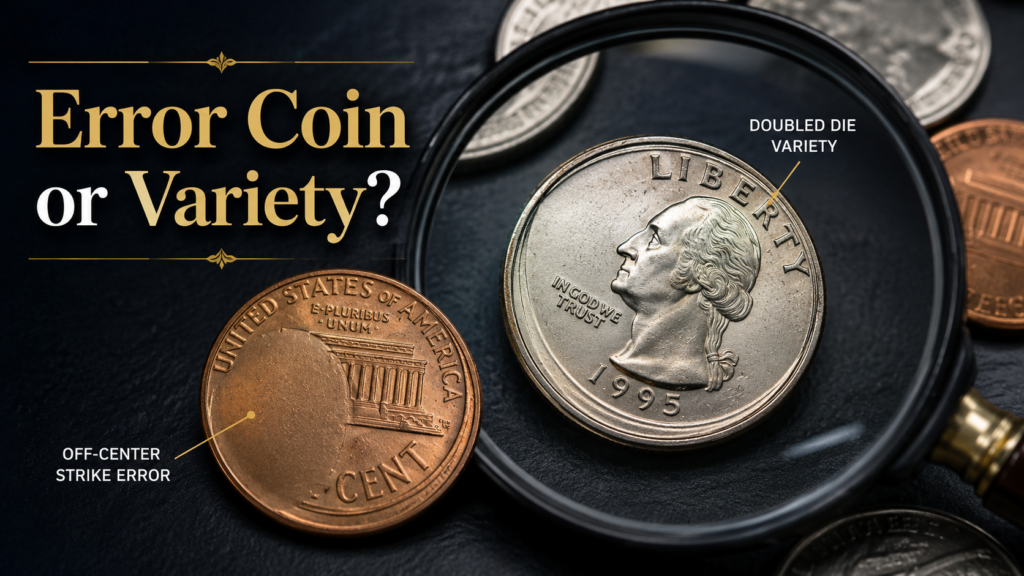
If you have ever looked at a strange-looking coin and wondered, “Is this an error coin or variety?” you are not alone. This is one of the most common questions new coin hunters ask, and honestly, it can be confusing at first.
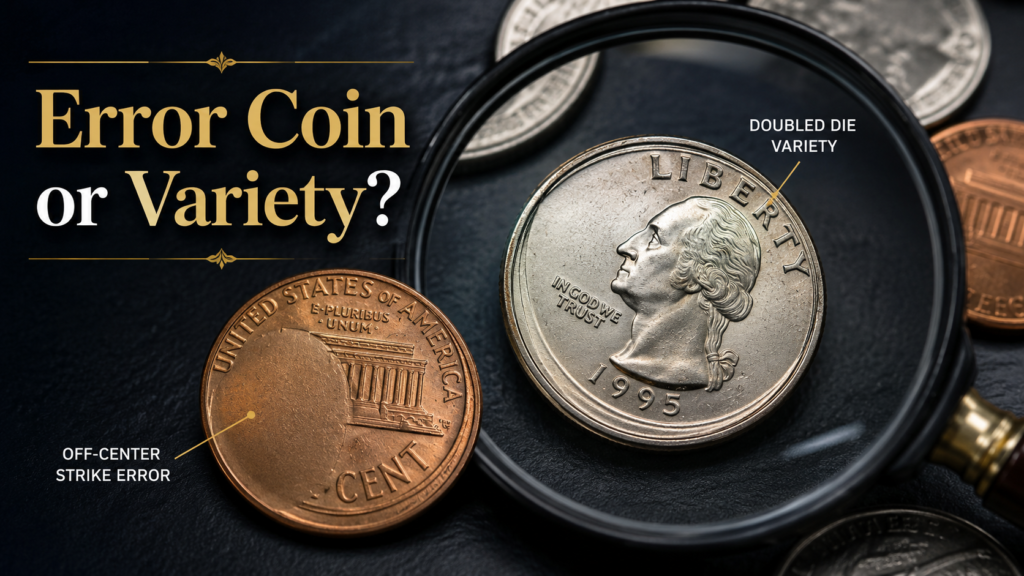
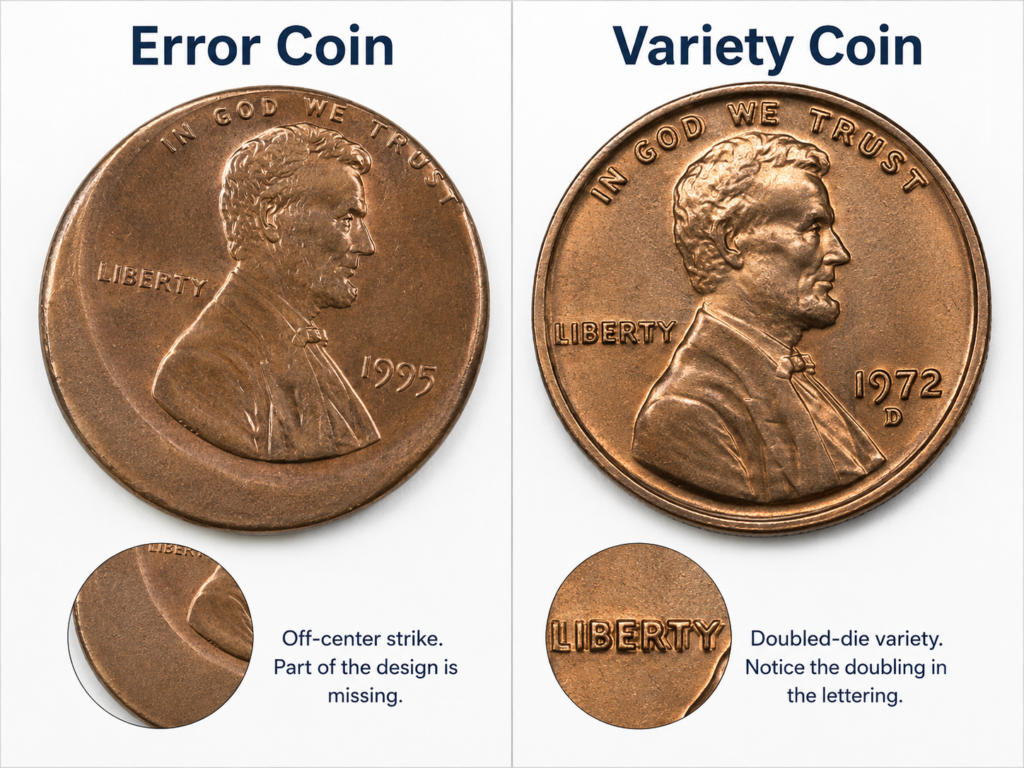
Before you read any more of this page, please know that these images were created with ai. This untrained ai is not very good at creating doubled die images. So just be aware that several doubled die images say they are doubled but they are not. It looks more like machine doubling. But since this is just a picture, there is no actual coin to say if it is a doubled die or not.... Don't use this page as a reference for doubled die images.
Some coins are valuable because something went wrong during the minting process. Other coins are valuable because they were struck from a die that already had a repeated design difference. Both can be exciting. Both can be collectible. But they are not always the same thing.
The simple way to remember it is this:
An error coin is usually a mint-made mistake that happens to an individual coin during production. A variety is usually a repeated difference caused by the die itself, meaning many coins struck from that same die may show the same feature.
That one sentence can save you a lot of confusion, wasted time, and bad advice from random comment sections.
What Is an Error Coin?
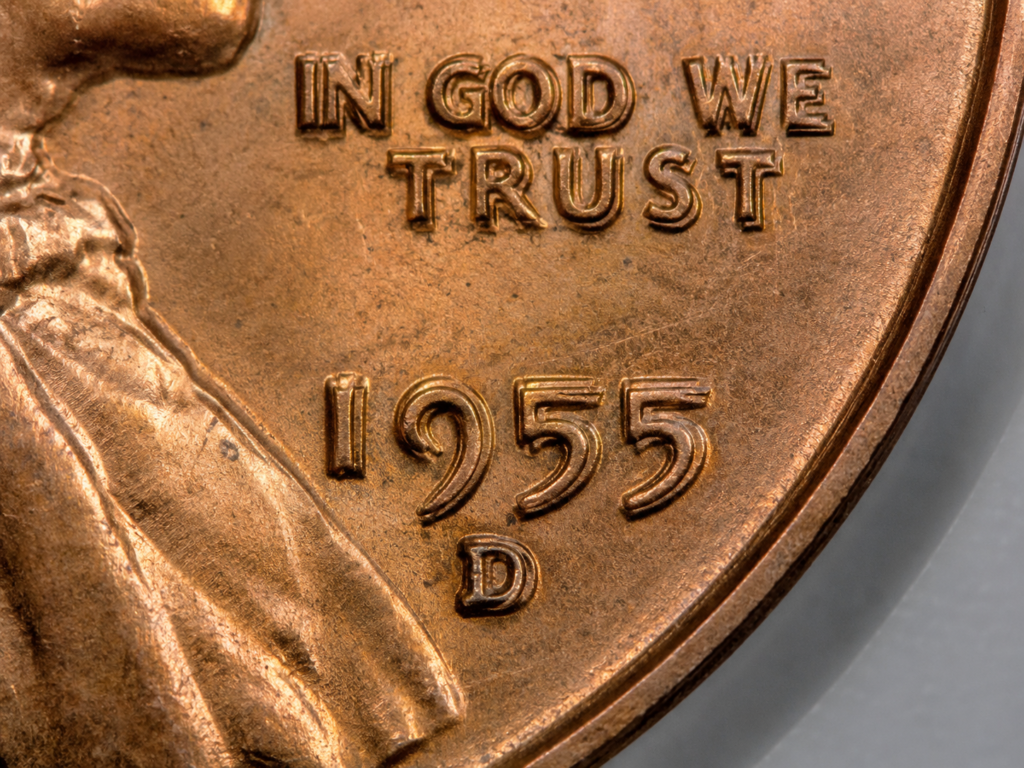
An error coin is a coin that was made incorrectly during the minting process. The mistake usually happens while the coin is being struck, handled, fed into the press, or produced from the wrong material.
Error coins are often unique or nearly unique because the mistake may only happen to one coin or a small number of coins.
Common examples of error coins include:
- Off-center strikes
- Broadstrikes
- Clipped planchets
- Wrong planchet errors
- Double strikes
- Struck-through errors
- Die caps
- Cuds and major die breaks
- Coins struck on the wrong metal
For example, if a penny is struck off-center and part of the design is missing, that is usually considered an error coin. The coin itself was not made the way it was supposed to be made.
Some error coins are worth very little. Others can be worth hundreds, thousands, or even more depending on the type of error, condition, rarity, and collector demand.
But here is the catch: not everything weird-looking is an error coin.
A lot of coins people think are errors are actually damaged after leaving the Mint. That damage is called post-mint damage, or PMD.
What Is a Coin Variety?
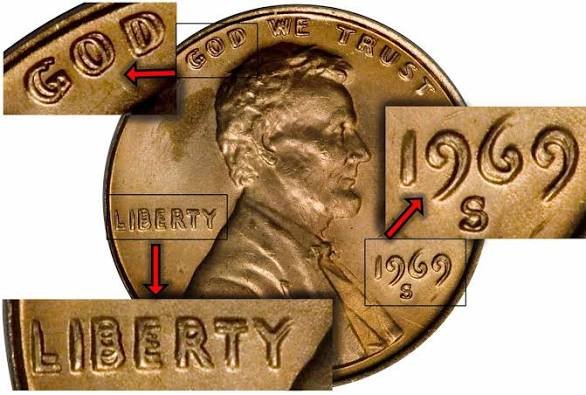
A coin variety is a coin that has a recognized design difference, usually caused by the die that struck the coin.
The die is the metal tool that stamps the design onto the blank coin. If something unusual is on the die, then every coin struck by that die can show the same unusual feature.
That is what makes varieties different from many one-time mint errors.
Common examples of coin varieties include:
- Doubled dies
- Repunched mint marks
- Overdates
- Large date and small date varieties
- Design changes
- Die markers used to identify a known variety
- Certain documented die cracks or die states
A famous example is a doubled die coin. A true doubled die is not the same as machine doubling. With a real doubled die, the doubling is part of the die itself. That means the doubling appears on the coins struck from that die.
That is why collectors search for specific known varieties by date, mint mark, and die markers.
Error Coin or Variety: The Main Difference
The easiest way to separate the two is to ask this question:
Did the problem happen to the coin, or did the problem come from the die?
If the mistake happened during the striking or production of that individual coin, it may be an error coin.
If the feature came from the die and appears the same way on other coins struck by that die, it may be a variety.
Here is a simple breakdown:
| Feature | Error Coin | Variety |
|---|---|---|
| Usually caused by | Minting or striking mistake | Difference on the die |
| Repeatable? | Usually not exactly | Yes, often repeated |
| Example | Off-center strike | Doubled die |
| Found on many identical coins? | Usually no | Often yes |
| Needs die markers? | Sometimes | Usually yes |
| Can be valuable? | Yes | Yes |
That is why two coins can both look unusual, but only one may be a true collectible variety.
Examples of Error Coins
Here are some common types of error coins collectors look for.
Off-Center Strike
An off-center strike happens when the blank coin is not properly centered when it is struck. Part of the design may be missing, and part of the coin may be blank.
The more dramatic the off-center strike, the more interesting it can be to collectors, especially if the date is still visible.
Clipped Planchet
A clipped planchet happens when the blank coin is cut incorrectly before it is struck. This can leave a curved or straight missing section on the coin.
Real clipped planchets usually have specific signs that help separate them from coins that were simply cut or damaged later.
Wrong Planchet Error
A wrong planchet error happens when a coin is struck on a blank meant for a different coin. For example, a penny design struck on a dime planchet would be a major error.
These can be very valuable because they are unusual and easy to identify when genuine.
Struck-Through Error
A struck-through error happens when something gets between the die and the coin during the strike. This could be grease, cloth, wire, or another foreign object.
The result may be missing details, strange impressions, or unusual texture on the coin.
Examples of Coin Varieties
Now let’s look at varieties.
Doubled Die
A doubled die happens when the die itself has doubled design elements. This can show up in letters, numbers, the date, or parts of the design.
True doubled dies are some of the most popular varieties in coin collecting.
Important note: machine doubling is not the same as a doubled die. Machine doubling usually happens during the strike and often looks flat, shelf-like, and less valuable.
Repunched Mint Mark
A repunched mint mark happens when a mint mark was punched into the die more than once in slightly different positions.
These are especially common on older coins from the era when mint marks were added to dies by hand.
Overdate
An overdate happens when one date appears over another date. This usually happened when dies were reused or modified.
Overdates can be very collectible because they are easy to understand and often have strong historical interest.
Large Date and Small Date Varieties
Some coins have different date styles in the same year. One version may have a large date, while another has a small date.
These are not always mint mistakes. Sometimes they are design varieties that collectors separate and value differently.
Why People Confuse Error Coins and Varieties
People confuse error coins and varieties because both can make a coin look strange.
A doubled die may look like an error. A die crack may look like damage. A damaged coin may look like a rare mint mistake. A coin with machine doubling may get mistaken for a valuable doubled die.
That is why you should never assume a coin is valuable just because it looks different.
You need to ask:
- Is the feature raised or sunken?
- Does it match a known variety?
- Is the same feature found on other coins?
- Does the coin show damage from circulation?
- Is the date and mint mark important?
- Are there die markers?
- Does it match trusted reference photos?
The goal is not just to find weird coins. The goal is to find real mint-made errors and recognized varieties.
That is where the money is.
Error Coin, Variety, or Damage?
This is where a lot of beginners get burned.
Many coins that look rare are actually damaged. Coins go through vending machines, parking lots, dryers, toolboxes, pockets, banks, wrappers, and years of abuse.
Common coin damage includes:
- Scratches
- Scrapes
- Heat damage
- Chemical damage
- Bent coins
- Dryer coins
- Coins hit with tools
- Environmental corrosion
- Glue, paint, or residue
- Coins smashed in parking lots
Post-mint damage does not usually add value. In most cases, it lowers the value.
A real error coin happens at the Mint. Damage happens after the coin leaves the Mint.
That difference matters.
Quick Test: Is It an Error Coin or Variety?
Use this simple test when checking your coin.
Error Coin:
- The coin was struck off-center
- Part of the design is missing from a striking issue
- It was struck on the wrong planchet
- It has a clipped planchet
- It shows a major die break or cud
- It has evidence of a mint-made production mistake
Variety:
- The feature matches a known documented variety
- Other coins from the same die show the same feature
- The doubling is part of the die, not flat machine doubling
- The coin has known die markers
- The date, mint mark, and design match a recognized listing
Most likely Damaged:
- The metal is pushed, scraped, or cut
- The coin looks melted, burned, or chemically altered
- The feature does not match any known error or variety
- The damage cuts into the coin instead of being struck into it
- The coin looks like it was hit, squeezed, drilled, or ground down
Are Error Coins or Varieties More Valuable?
Neither one is automatically better.
There are error coins that sell for ten bucks and some that sell for thousands of dollars. The same is true for variety errors as well.
Value depends on:
- Rarity
- Demand
- Coin condition
- Date and mint mark
- Type of error or variety
- Eye appeal
- Authentication
- How easy it is to identify
- Whether collectors are actively searching for it
A dramatic off-center strike with a visible date may bring strong money. A well-known doubled die may also bring strong money. But a minor die chip or common machine doubling may not be worth much at all.
The real value comes from knowing what you have.
Best Way to Identify Your Coin
If you are trying to figure out whether you have an error coin or variety, follow these steps:
- Identify the coin’s date, mint mark, and denomination.
- Look up known varieties for that exact coin.
- Compare your coin to verified photos.
- Check for die markers.
- Rule out post-mint damage.
- Take clear close-up photos in good lighting.
- Weigh the coin if a wrong planchet is possible.
- Consider professional grading or attribution for valuable finds.
Never rely on one blurry photo or one random opinion. Coin identification is about evidence.
That is exactly why Rich Off Error Coins exists — to help collectors slow down, compare details, and learn what actually matters.
Final Answer: Error Coin or Variety?
So, is your coin an error coin or variety?
Here is the simplest answer:
An error coin is usually a mint-made mistake that happened during the production of that individual coin.
A variety is usually a repeated design difference caused by the die, meaning other coins struck from that same die can show the same feature.
Both can be valuable. Both can be exciting to find. But they are not the same thing.
Before you sell, grade, post, or toss that strange coin back into the jar, take the time to identify it correctly. The difference between damage, an error, and a real variety could be the difference between pocket change and a serious collectible.
FAQ Section
What is the difference between an error coin and a variety?
An error coin is usually a mint-made mistake that happens during production. A variety is usually a repeated difference caused by the die used to strike the coin.
Is a doubled die an error coin or variety?
A true doubled die is usually considered a variety because the doubling is part of the die and can appear on multiple coins struck from that die.
Is machine doubling valuable?
Most machine doubling is not very valuable. It is often confused with true doubled die doubling, but it usually looks flat and shelf-like.
Are all strange-looking coins valuable?
No. Many strange-looking coins are damaged after leaving the Mint. Post-mint damage usually does not add value.
Can an error coin be worth money?
Yes. Some error coins can be valuable, especially dramatic errors like wrong planchet errors, major off-center strikes, double strikes, and certain struck-through errors.
Can a variety coin be rare?
Yes. Some varieties are rare and highly collectible, especially famous doubled dies, overdates, repunched mint marks, and scarce date/mint mark combinations.