Types of Error Coins
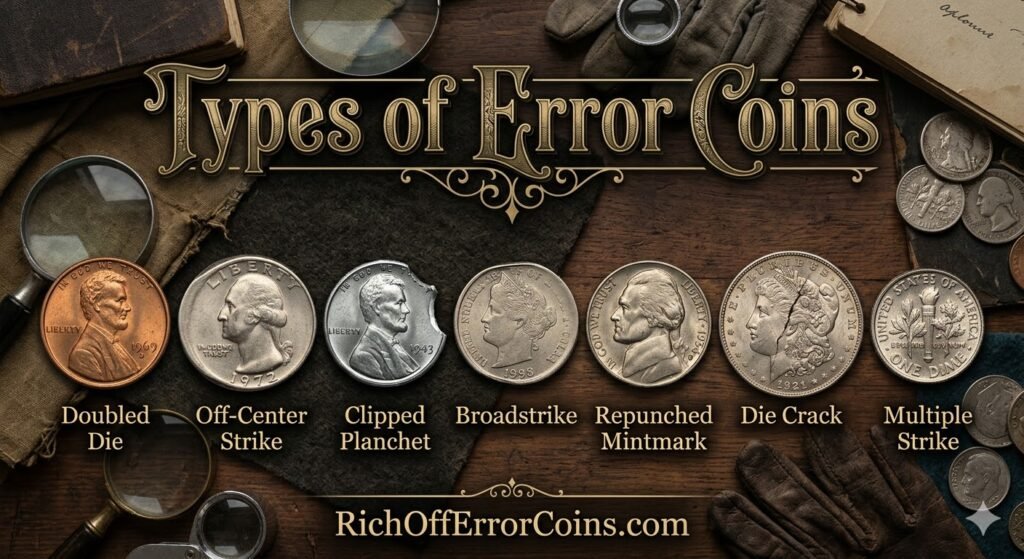
If you look closely at your pocket change, you may notice something unusual. Some coins show mistakes from the minting process. Collectors call these error coins. In some cases, these mistakes can make a coin worth hundreds or even thousands of dollars.In this guide, you will learn about the most important types of error coins, how they occur, and how to identify them.
If you are interested in making money from pocket change, be sure to subscribe to the page and become a member of the site!
Become a member of Rich Off Error Coins!

Both beginners and experienced collectors benefit from understanding these mint mistakes. When you know what to look for, you can spot valuable coins that most people overlook.
What Are Error Coins?
An error coin forms when something goes wrong during the coin production process. The mistake can happen at several stages of minting.
These stages include:
- Preparing the metal blank (called a planchet)
- Creating the dies that stamp the design
- Striking the coin inside the press
The U.S. Mint uses strict quality control to prevent mistakes. Most defective coins never leave the mint. However, some still slip through and enter circulation. When that happens, collectors often search for them because of their rarity.
The Three Main Categories of Error Coins
Collectors usually divide types of error coins into three main categories. The category depends on when the mistake occurred during production.
Planchet Errors – problems with the metal blank before the coin is struck.
Die Errors – mistakes in the die used to stamp the coin.
Strike Errors – problems that occur during the actual strike.
Each category contains several specific coin errors.
Types of Error Coins
Learning the different types of error coins helps collectors recognize valuable mint mistakes. These errors occur when equipment shifts, dies wear out, or planchets form incorrectly.
Some errors are rare and valuable. Others are common and worth only a small premium. Understanding how each error forms will help you identify genuine mint errors and avoid confusing them with normal damage.
Below are some of the most well-known types of error coins.
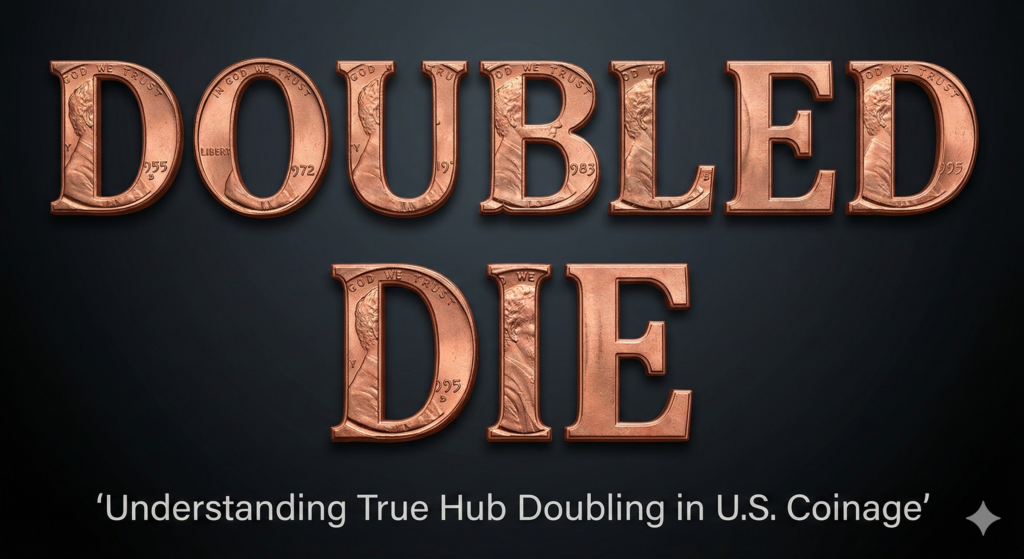
Doubled Die Error
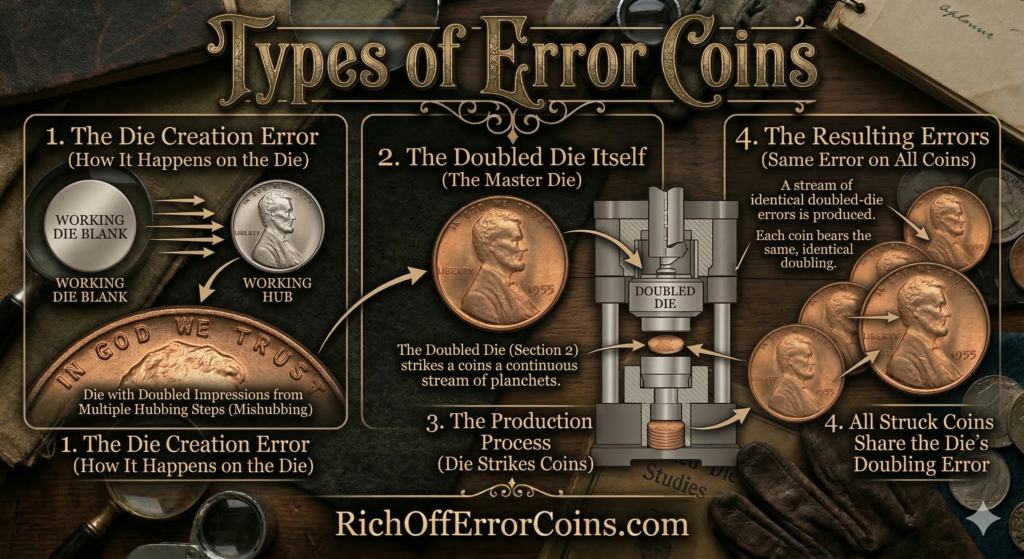
The doubled die is one of the most famous types of error coins. This error forms during the creation of the coin die. The die receives the design more than once, but the impressions do not line up perfectly.
Because the die itself contains the doubling, every coin struck by that die will show the same error.
A true doubled die creates strong and clear doubling on letters, numbers, or design elements. You can often see sharp separation lines between the images. The doubling looks bold and distinct, not flat or blurry.
Several famous coins display this error. The 1955 Doubled Die Lincoln Cent, 1969-S Doubled Die Cent, and 1972 Doubled Die Cent are well known among collectors. Some of these coins sell for thousands of dollars depending on their condition.
Collectors value doubled dies because they originate from the die itself. However, beginners must learn to separate true doubled dies from machine doubling, which is far more common.
Off-Center Strike
An off-center strike happens when the planchet sits incorrectly inside the press during striking. When the dies strike the coin, only part of the design lands on the metal.
The rest of the coin remains blank.
Off-center strikes vary widely in appearance. Some coins show only a small crescent of missing design. Others miss half of the design or more. Collectors usually prefer coins that still show the full date while displaying a large blank area.
These errors are easy to spot because the blank space stands out clearly. The unusual appearance makes them popular among collectors.
Among all types of error coins, off-center strikes are some of the easiest to recognize and one of the most exciting to find in circulation.
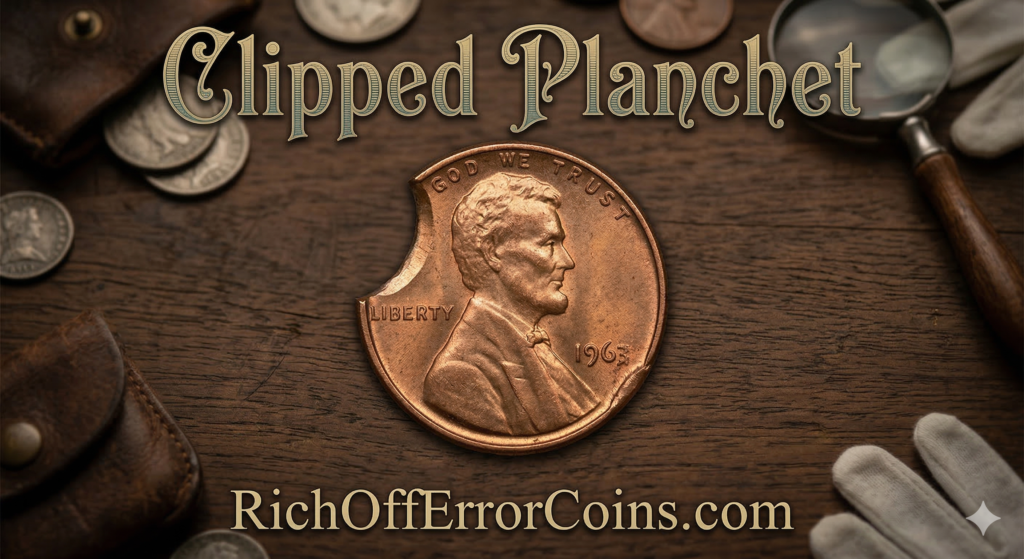
Clipped Planchet Error
A clipped planchet forms before the coin receives its design. The mint punches round planchets from large metal sheets. If the punching machine overlaps a previously cut hole, the planchet loses a portion of its edge.
When the mint strikes this incomplete blank, the finished coin shows a curved missing section. Most clips form a crescent shape, but other shapes can occur.
Collectors look for a feature called the Blakesley Effect to confirm the error. This effect causes weakness in the rim directly opposite the clipped area. The missing metal changes how pressure spreads during the strike.
Clipped planchets are a classic example of types of error coins that begin before the strike even occurs.
Broadstrike Error
A broadstrike happens when the collar fails to hold the coin during the strike. The collar normally surrounds the planchet and keeps the metal from spreading outward.
Without the collar, the coin expands when the dies strike it.
Broadstruck coins appear wider than normal. The edge may look flat or lack the usual rim detail. The coin may also appear slightly thinner because the metal spreads outward.
This error shows how important the collar is during minting. Without it, the coin cannot hold its normal shape.
Broadstrikes remain a popular example among collectors studying different types of error coins.
Die Crack
A die crack forms when the coin die begins to wear out. Each die strikes thousands of coins under intense pressure. Over time, the steel die can develop cracks.
When the cracked die strikes a coin, metal flows into the crack. This creates a raised line on the coin’s surface.
Some die cracks appear as thin lines across the coin. Others form branching patterns that look like lightning bolts. In severe cases, a piece of the die may break away completely. This creates a larger raised area called a cud.
Die cracks appear more often than other types of error coins because dies eventually wear out during production.
Multiple Strike Error
A multiple strike error occurs when a coin remains inside the press after the first strike. The machine then strikes the coin again before ejecting it.
This produces overlapping images on the coin.
The most common version is a double strike. The second strike may occur after the coin shifts position, which creates a dramatic overlapping design. In rare cases, a coin may receive three or more strikes.
Each additional strike can distort the design further. Some coins show rotated images or partially missing details.
Among all types of error coins, multiple strike errors often create the most dramatic and unusual appearances.
Mule Error
A mule error occurs when the mint pairs two dies that were never meant to work together. The obverse and reverse designs belong to completely different coins.
These errors are extremely rare because the mint carefully tracks each die pair.
One famous example is the Sacagawea Dollar / Washington Quarter mule. This coin shows George Washington on one side and the Sacagawea dollar design on the other. Only a few examples exist, and they have sold for six-figure prices.
Because of their rarity, mule errors rank among the most fascinating types of error coins known to collectors.
Worthless Doubling (Machine Doubling)
Not every doubled coin is valuable. One of the most common forms of doubling is machine doubling, also called mechanical doubling.
Machine doubling occurs during the strike when the die shifts or vibrates slightly. The movement scrapes the design and creates a flat, shelf-like doubling effect.
Unlike a true doubled die, machine doubling does not show clear separation between images. The design usually appears flattened or smeared.
This type of doubling appears frequently on circulation coins. Because the die itself does not contain the error, collectors generally consider machine doubling worthless.
Learning to recognize machine doubling helps collectors avoid mistaking common defects for valuable types of error coins.
Final Thoughts on Types of Error Coins
Learning the different types of error coins helps collectors understand how coins are made and how mistakes occur at the mint.
Some errors create dramatic coins with missing designs or multiple images. Others appear as small details like die cracks. Each one tells a story about what happened during the minting process.
Many collectors discover valuable errors simply by examining their change carefully. With the right knowledge, even an ordinary coin can become an exciting find.
If you want to learn more about valuable mint errors and rare varieties, explore the guides available throughout Rich Off Error Coins.