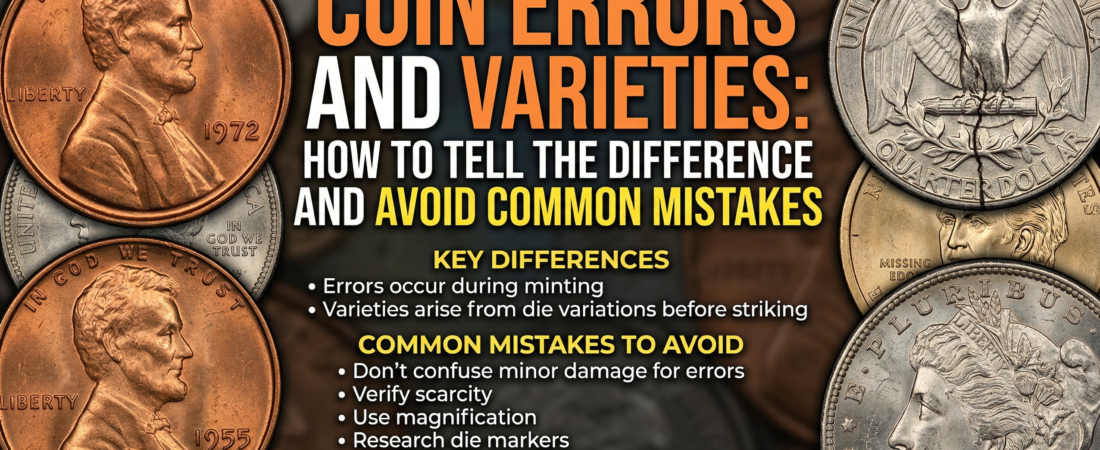
If you’ve been searching for coin errors and varieties, you’re not alone—most collectors (and pocket-change hunters) mix the two up at first. That confusion can be expensive: it leads to paying “error coin” prices for damaged coins, missing real die varieties hiding in plain sight, or submitting the wrong thing for attribution and grading.
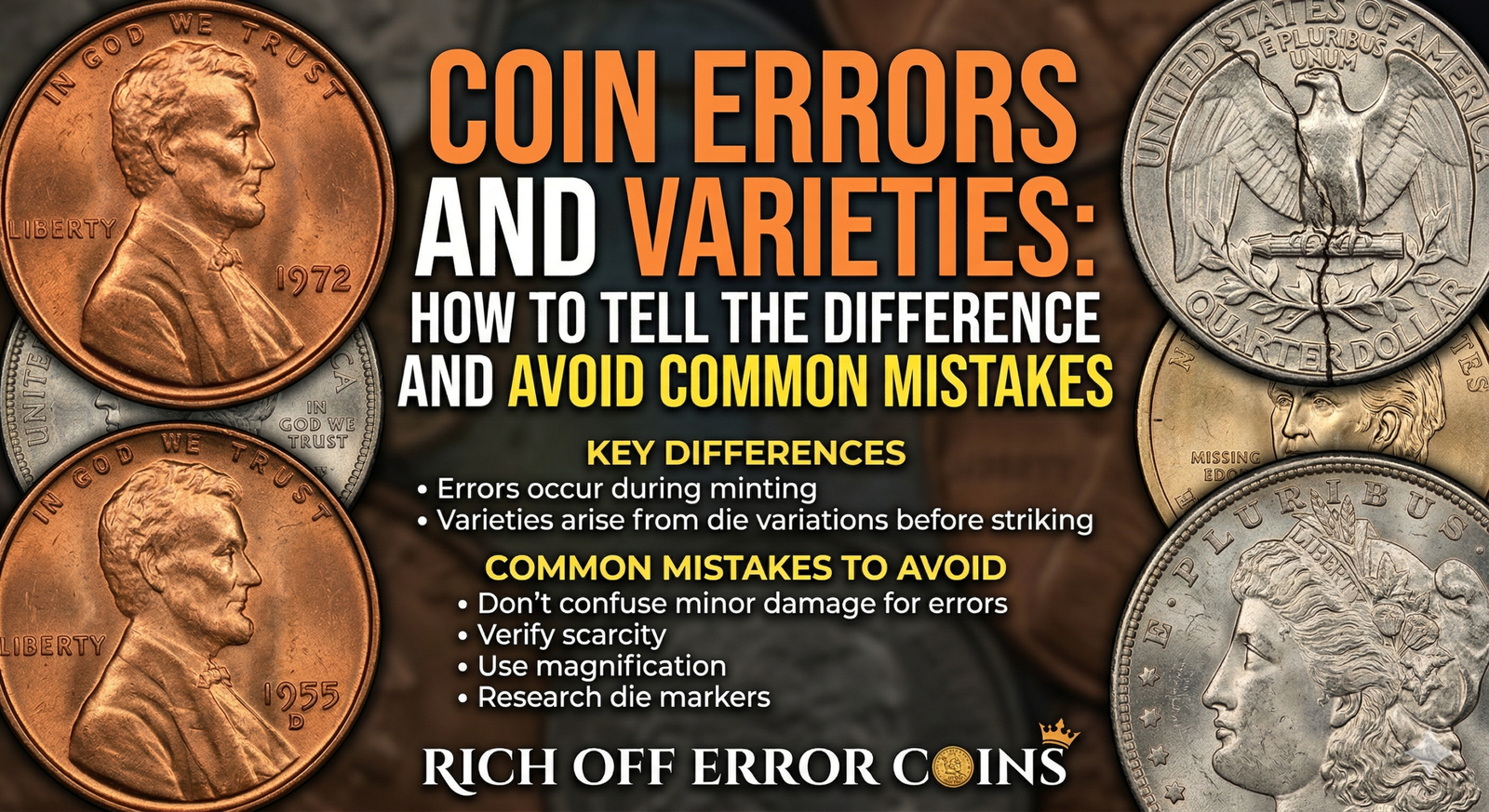
This guide breaks it down in plain English, shows you how to tell the difference, and gives realistic value expectations—without the hype.
What’s the Difference Between Coin Errors and Varieties?
Here’s the core rule that saves collectors the most money:
- Variety = repeatable (many coins can share the same markers)
- Error = often one-off (a mistake affects that individual coin’s strike)
Coin Varieties (Die-Related and Repeatable)
A coin variety is a collectible difference tied to the die (or die pair) that struck the coin. Because the die keeps striking coins until it’s retired, the same diagnostics can appear on multiple examples.
Common variety types collectors chase include:
- Doubled dies (true hub doubling)
- Overdates
- Repunched mintmarks / repunched dates
- Other cataloged die markers that repeat across multiple coins
Error Coins (Minting Mistakes on Individual Coins)
An error coin comes from a mistake during the minting process—something went wrong with the planchet, die, or strike. Even if two errors are the “same type,” they usually won’t match perfectly in position and severity.
Learn more about error coins here at Rich Off Error Coins! Check out our page titled Types of Error Coins
Common examples include:
- Off-center strikes
- Broadstrikes
- Clipped planchets
- Wrong planchets
- Brockages
- Mules (mismatched dies)
- Cuds / major die breaks
Explanation: Why This Distinction Matters
Calling something an “error” vs a “variety” changes:
- How it’s authenticated
- How it’s attributed
- How it’s valued
- How easily it sells
Varieties are often cataloged, which makes them easier to verify and trade consistently. Errors can be dramatic and valuable—but they’re also far more vulnerable to being confused with (or faked by) damage and alterations.
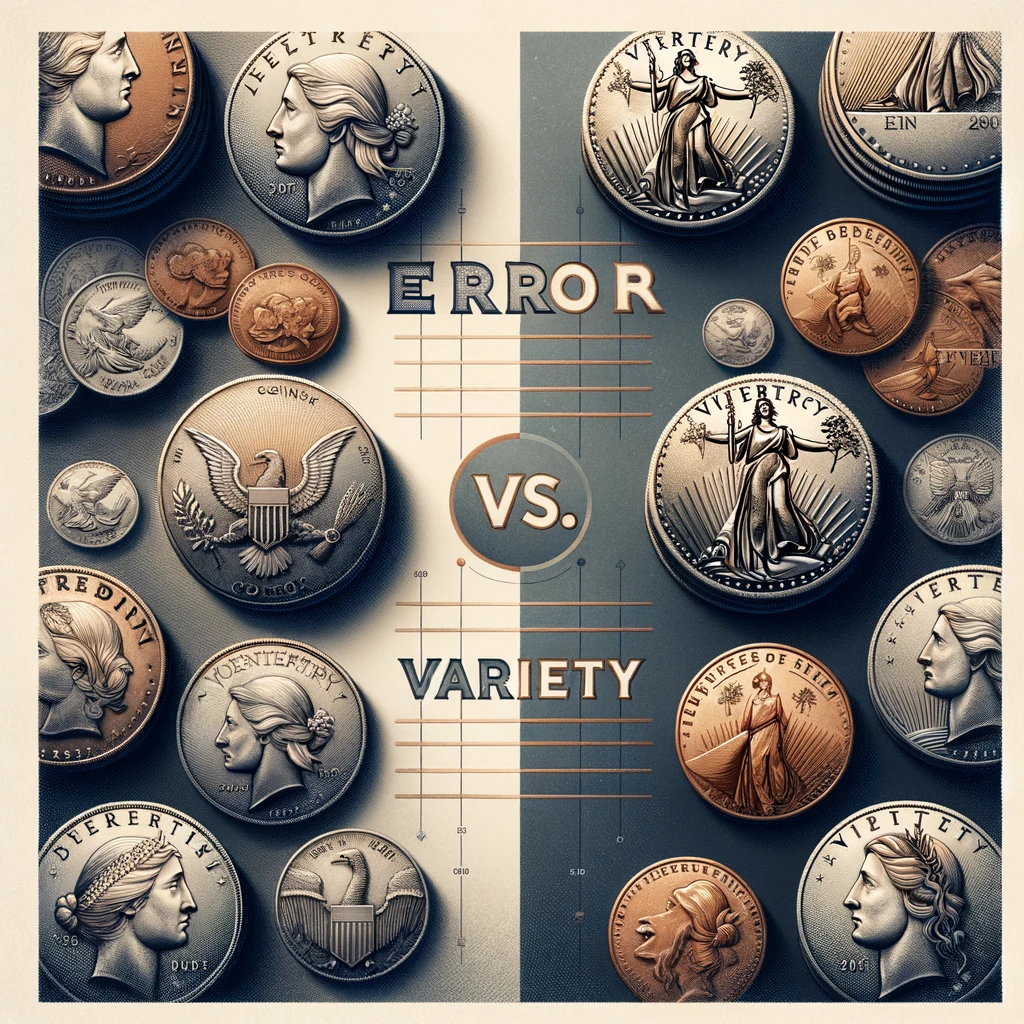
Identification: How to Tell If You Have an Error or a Variety
Use this quick checklist:
Step 1: Ask “Does this repeat?”
- If the exact same markers show up on multiple coins → likely a variety
- If it looks like a one-off event → move to Step 2
Step 2: Ask “Does it match minting mechanics?”
Real mint-made issues usually line up with how coins are produced:
- Collar effects (broadstrike, partial collar)
- Planchet problems (clips, wrong planchet)
- Die failures (cuds, die breaks)
- Strike problems (off-center, multiple strikes)
If it doesn’t make mechanical sense, it’s often damage.
The Most Common Mix-Up: Doubled Die vs Double Strike
This one causes endless confusion:
- Doubled die = die creation issue that repeats → variety
- Double strike = coin struck twice due to a striking mishap → error
Value: Realistic Price Ranges (No Hype)
Value depends on:
- Rarity
- Demand
- Eye appeal
- Grade
- Whether it’s recognized and verifiable
Here are realistic “what to expect” ranges for most collectors:
Typical Coin Varieties
- Minor/extra die markers: small premium or collector interest
- Recognized doubled dies / popular listed varieties: can range from modest premiums to strong value depending on the specific variety and condition
Typical Error Coins
- Minor errors: often small premiums
- Clear, dramatic errors (off-center, wrong planchet, major brockage, strong cud): can command significant premiums—especially when the coin is attractive and easy to explain
The key: if you can’t clearly identify and describe the coin with diagnostics and known mechanics, the market usually won’t pay much extra.
Common Mistakes (That Cost People Money)
This is one of the biggest mistakes beginners make is mistaking PMD (or Post Mint Damage – which means it happend after leaving the mint) for a valuable error coin. Not every messed up looking coin is a valuable error coin, in fact, the majority of funny looking coins are just funny looking coins. If it happened after leaving the mint, the error is NOT valuable.
1) Calling Damage an Error
The #1 trap: post-mint damage that “looks cool,” like:
- Scrapes and gouges
- Heat damage
- Smashed rims
- Grinding marks
- Alterations meant to imitate errors
Damage usually reduces value.
2) Confusing Strike Doubling With a Doubled Die
Machine/strike doubling is common and usually doesn’t carry the premium that true doubled dies do. True doubled dies are repeatable and show consistent hub doubling characteristics.
3) Submitting the Wrong Thing for Attribution
Varieties often need attribution (specific listing), while errors need error classification—mixing them up wastes time and money.
FAQ (Featured Snippet Friendly)
Is a doubled die a mint error or a variety?
Collectors may casually call it an “error,” but it’s typically treated as a variety because the doubling comes from the die and repeats across multiple coins.
What are the main types of mint errors?
Most mint errors fall into three categories: planchet errors, die errors, and strike errors.
If two coins look the same, does that mean it’s not an error?
If the exact diagnostics repeat on many coins, it’s often a variety (the “many vs one” rule).
How can I tell if it’s damage instead of an error?
If the feature doesn’t match minting mechanics—or looks like scraping, crushing, or alteration—it’s likely post-mint damage, not a mint error.
Do grading services refuse altered “errors”?
Major graders generally won’t certify coins that appear to be human-made alterations rather than mint-made results.

Become a Member of Rich Off Error Coins
Want help figuring out whether your coin is a real mint error, a true variety, or just damage?
Create a free account and get access to collector-focused resources designed to help you identify coins faster and avoid the most common (and expensive) mistakes:
👉 https://richofferrorcoins.com/registration