The difference between mint variations and damage
 admin
adminThis post contains affiliate links. If you buy through them, we may earn a small commission at no extra cost to you. As an Amazon Associate I earn from qualifying purchases.
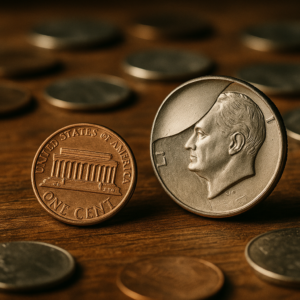
A coin feature must have been created during the minting process to be a mint variation or error; if it happened after the coin left the Mint, it is damage. That simple rule is the foundation of the difference between mint variations and damage, but applying it correctly takes careful observation.
Collectors regularly find coins with odd marks, flattened lettering, unusual color, doubled-looking design elements, and missing-looking details. Some are legitimate products of dies, planchets, or striking. Many more are the results of circulation, tools, chemicals, heat, jewelry use, or well-meaning attempts to “improve” a coin. The goal is not to guess from one dramatic-looking spot. It is to look for physical evidence that tells a coherent manufacturing story.
The difference between mint variations and damage starts with timing
The most useful question is: When did this feature happen?
A mint-made feature occurs before or during striking, or as part of a die’s use in producing coins. A coin may have an unusual planchet, a striking problem, or a repeatable die characteristic. These can be collectible when they are genuine and identifiable.
Damage happens after the coin was struck. It can occur in pockets, cash drawers, soil, machinery, dryers, parking lots, jewelry mounts, or someone’s workshop. A damaged coin may look unusual, but unusual is not the same as mint-made.
This timing test also explains why the same-looking feature can have very different meanings. A broad area of flatness may be a weak strike, a post-strike abrasion, or intentional grinding. A doubled letter may be a die variety, mechanical doubling from the strike, or damage that pushed metal around. The surrounding surfaces and the shape of the metal decide the issue.
Mint variation, die variety, and mint error are not identical terms
Collectors often use “mint variation” loosely. It helps to separate three ideas:
| Term | What it means | Typical identifying trait |
|---|---|---|
| Die variety | A repeatable feature on a die, transferred to every coin struck by that die while the feature remains | Matching characteristics can be found on more than one coin |
| Mint error | An unintended problem involving the planchet, dies, press, or striking process | The feature is physically consistent with how coins are made |
| Post-mint damage | A change after production | Disturbed metal, scratches, dents, altered surfaces, or inconsistent shapes |
A die variety is generally repeatable. An individual error can be more isolated because it may result from a one-time disruption in production. Neither category includes ordinary wear or damage.
What genuine mint-made features tend to show
The difference between mint variations and damage becomes clearer when you stop looking only at the headline feature and examine the metal around it. Legitimate mint-made anomalies usually preserve evidence of pressure, flow, and original surfaces.
The design and metal work together
During a normal strike, metal flows into recessed areas of the dies to form the design. When something unusual occurs, the result still follows the physics of striking.
For example, a genuine doubled-die variety shows design elements created from differing die impressions. The doubling is part of the struck design, rather than a second image scraped or shoved into the surface later. Depending on the variety, separation or notching may be visible in the affected letters or devices. By contrast, flat shelf-like doubling is often mechanical doubling, a strike-related effect that is usually not a collectible die variety.
Similarly, a strike-through feature is created when foreign material comes between a die and planchet. It may leave an incuse or distorted area that conforms to the struck surface. It should not look like a random gouge that cut across a finished coin after it was made.
Original luster can be a useful clue
On uncirculated coins, original mint luster often moves across the surface as the coin is tilted under a single light source. A legitimate mint-made feature may share the surrounding original surface texture because it was present at the time of production.
Damage commonly interrupts that surface. Scratches can appear brighter, duller, or differently textured than nearby metal. A rubbed patch may lose luster. A tool mark may leave sharp, unnatural edges. This is not an absolute test—circulation and handling complicate surface appearance—but it is a valuable part of the overall diagnosis.
Repeatability matters for varieties
If you suspect a die variety, do not rely on a single coin or a vague resemblance to an online photo. Compare the exact locations, shapes, and direction of the suspected markers with reliable variety references. A true die marker repeats because it was on the die.
The fact that two coins both have a mark near a letter is not enough. Marks from circulation can land anywhere. A convincing match requires the same specific feature in the same place, with the same form, and preferably supporting die markers.
Common forms of damage mistaken for mint variations
Knowing the common traps is often more valuable than memorizing every possible error. The following conditions frequently lead collectors away from the real difference between mint variations and damage.
Scratches, gouges, and cuts
A scratch removes or displaces metal after striking. Under magnification, it often has a narrow path, sharp borders, and irregular interruptions where it crosses design elements. It may run over letters, the portrait, and fields without regard for the coin’s original contours.
A mint-made feature may distort a design, but it typically does so in a way that corresponds to the pressure of the strike. It should not resemble a casual line dragged across the finished surface.
Contact marks and dents
Coins strike one another and hard objects in commerce. The resulting nicks and dents can be deep enough to look dramatic. Look for compressed metal, irregular impact points, and disturbed rims. A dent near the edge is especially likely to be contact damage unless there is compelling evidence of a genuine collar or striking issue.
Heat, chemicals, and environmental effects
Color alone is not an error. Toning, staining, corrosion, plating loss, and chemical alteration may be visually striking, but they are not automatically mint-made. Artificially altered surfaces can also hide details that collectors mistake for weak strikes or unusual planchets.
Avoid harsh cleaning. Cleaning can leave hairlines, alter luster, and reduce collector appeal, while also making it harder to determine what was original. If a coin needs conservation, seek qualified guidance rather than experimenting with abrasives, dips, or household chemicals.
Flattened details and apparent missing letters
Worn coins often have softened lettering and reduced detail on high points. Damage can flatten a small area even more severely. Before calling a letter “missing,” check whether the area has been worn, scraped, or compressed.
A true die-related missing-design feature generally has a consistent relationship to the surrounding design and may be documented on other coins from the same die. A damaged coin often shows a break in surface texture, a depression, or displaced metal at the supposed missing area.
Edge damage and altered rims
The edge provides some of the best evidence of post-mint handling. File marks, crimping, vise pressure, mounting damage, and pry marks often disturb the rim and edge together. The metal may look folded, squeezed, or torn.
A genuine minting issue involving the collar or planchet can affect the rim, but it should show a plausible production pattern. Examine the entire circumference, not only the most unusual section.
A practical inspection method
You do not need expensive equipment to make better first-pass decisions. A careful routine reduces excitement-driven mistakes.
1. Handle the coin safely
Hold collectible coins by their edges over a soft surface. Avoid touching the faces, especially if the coin appears uncirculated. Do not clean it before identifying it; cleaning can erase diagnostic evidence.
2. Check the whole coin before zooming in
Look at both sides, the rim, and the edge. Ask whether the coin has widespread wear, obvious impact damage, corrosion, or altered color. A close-up feature cannot be judged well when the overall condition is ignored.
3. Use magnification and directional light
A loupe or other modest magnifier is helpful, but lighting matters just as much. Rotate the coin under a single light source. Changing the angle can reveal raised metal, depressions, luster breaks, hairlines, and tool marks that are invisible under flat room lighting.
Photograph both sides and any suspect area. Take one straight-on image and additional images with angled lighting. Photos are useful for comparison, but do not let blurry enlargement create details that are not really present.
4. Identify whether the feature is raised, incuse, or displaced
This question is central to the difference between mint variations and damage. Is the feature part of the struck design? Is it pressed into the coin? Has metal been pushed to one side? Are there sharp exposed edges?
Post-strike damage often leaves displaced metal or broken surface texture. Mint-made effects can also create unusual relief, but they should make mechanical sense within the striking process.
5. Compare, then form a conclusion
Compare the coin to normal examples of the same type, when possible. Then consult established references for the specific variety or error you think you see. Search for diagnostic descriptions, not only a label such as “rare error.”
If the evidence is weak, the correct conclusion is “unconfirmed,” not “rare.” That restraint protects both your collection and your wallet.
Quick comparison: mint-made feature or damage?
Use this table as a screening tool, not as a substitute for attribution.
| Question | More consistent with a mint-made feature | More consistent with damage |
|---|---|---|
| Does the feature fit the production process? | Yes; it follows struck design, planchet, die, or press mechanics | No; it looks cut, crushed, scraped, bent, or chemically altered |
| Is the surface texture continuous? | Often, especially on unworn pieces | Often interrupted by luster breaks, roughness, or fresh-looking metal |
| Is metal displaced unnaturally? | Not usually in a random direction | Often visible around dents, gouges, and tool marks |
| Can a die variety be matched precisely? | Exact diagnostics and supporting markers may match | Marks are isolated, random, or inconsistent |
| Does the rim and edge support the story? | The whole coin shows a plausible production pattern | Edge pressure, filing, or impact suggests later alteration |
When to seek a second opinion
Consider experienced help when a coin has a feature that remains plausible after your inspection, especially if it appears to be a documented die variety, a significant striking anomaly, or an unusual planchet issue. Clear images, the coin’s basic identification, its weight if measured with a suitable scale, and an honest description of what you observe will make a second opinion more useful.
Be cautious with sellers or online posts that identify every odd coin as an error. A confident label is not evidence. The strongest conclusions explain why the feature could have happened at the Mint and rule out more ordinary explanations.
The collector’s mindset that prevents costly mistakes
The difference between mint variations and damage is not decided by how strange a coin looks. It is decided by evidence: the shape of the feature, the flow and condition of the metal, the behavior of the design, the rim and edge, and, for varieties, repeatable diagnostics.
Treat each unusual coin as a small investigation. Start with the possibility of damage because post-mint alteration is common, then move toward a mint-made explanation only when the physical evidence supports it. That approach makes real finds more satisfying and keeps everyday damaged coins from becoming expensive misidentifications.
Where to find difference between mint variations and damage
Enjoyed this guide? Sign up for a free Rich Off Error Coins membership to receive practical coin-identification guides and collecting insights in your inbox. It is a simple way to build sharper habits before your next coin search.
\ Get the latest news /