Learn About Error Coins and Varieties: A Beginner’s Guide
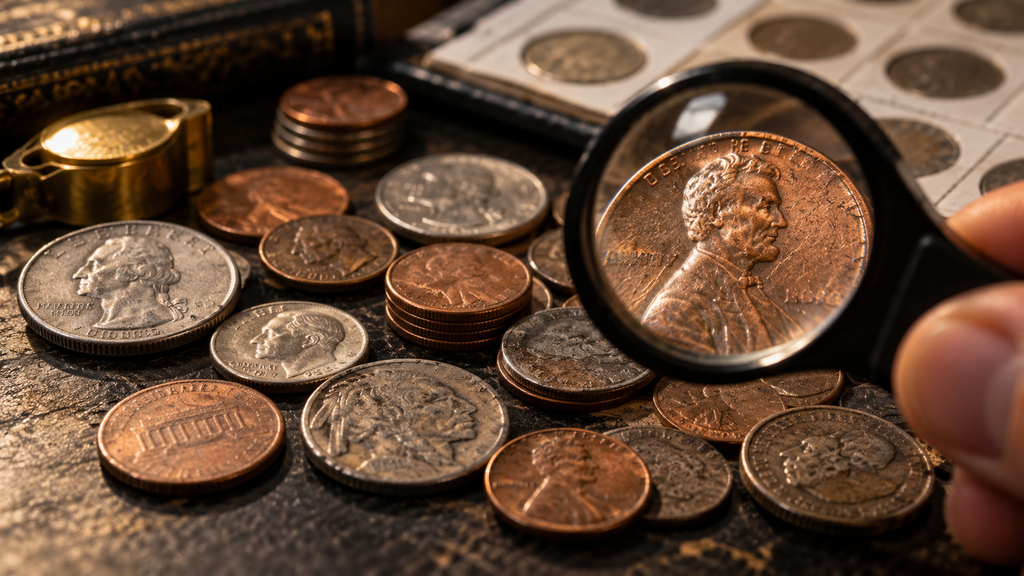
A coin doesn’t have to look dramatic to be interesting. Sometimes the clue is an off-center design you can spot immediately. Other times, you need a close look at a letter, mintmark, or tiny line near the rim.
If you want to learn about error coins and varieties, start with one question: When did the difference happen? The answer helps you separate a mint error, a die variety, and ordinary damage.
Featured image: Collector examining coins with a magnifying glass.
Alt text: Collector uses a magnifying glass to examine U.S. coins for errors and varieties.
What Is an Error Coin?
An error coin was made incorrectly during production and escaped the mint. The problem may involve the blank piece of metal, called a planchet, the dies that strike the design, or the strike itself. The U.S. Mint lists off-center strikes, multiple strikes, and clipped planchets among the errors collectors may encounter.
Here are a few examples:
- Off-center strike: Part of the design misses the planchet because the coin was not properly positioned when struck.
- Clipped planchet: A portion of the metal blank is missing before the coin receives its design.
- Multiple strike: The coin receives more than one strike, which may leave overlapping impressions.
- Die break: A damaged die can leave a raised area of extra metal on coins it strikes.
An unusual shape or mark does not prove a coin is a mint error. You still need to work out how that feature could have formed during production.
Image 2: Two coins illustrating an off-center design beside a normally centered design.
Alt text: Illustrative comparison of a centered coin design and an off-center strike.
Image note: This is an illustration of the concept, not a photograph of an authenticated error coin.
What Is a Coin Variety?
A coin variety has an identifiable design difference associated with the die used to make it. If that die strikes many coins, multiple coins can carry the same distinguishing details.
A doubled die is one well-known example. Collectors compare specific parts of the design, such as lettering or the date, to determine whether a coin matches a documented variety. Other varieties may involve details such as mintmark placement or spacing in the design.
That last point matters. A coin with doubled-looking letters is not automatically a doubled die. Machine doubling and die deterioration can produce other forms of doubling that collectors may mistake for a recognized variety.
When you research a possible variety, look for its identifying markers. A good reference should tell you exactly where to look and show clear comparison photos.
Error Coin vs. Variety: What’s the Difference?
The terms can overlap in everyday conversation, but this distinction gives beginners a useful place to start:
| What you found | First question to ask | Example |
|---|---|---|
| Possible mint error | Did something go wrong while this coin was being made? | An off-center strike |
| Possible variety | Does this coin match a documented difference from a particular die? | A recognized doubled die |
| Possible post-mint damage | Could this have happened after the coin left the mint? | A gouge, scrape, or flattened area |
Don’t force a coin into a category based on one photo. Inspect both sides, the edge, and the surrounding metal. A mark that looks unusual from above may look very different under angled light.
The Most Common Beginner Mistake: Confusing Damage With an Error
Coins get dropped, scraped, squeezed, corroded, cleaned, and run through machinery after they leave the mint. That damage can imitate a missing design, an unusual edge, or even apparent doubling.
A clipped planchet is a good example of why the cause matters. NGC notes that metal flow near a missing section can help distinguish a genuine clip from metal removed after minting. That is a clue to investigate, not a shortcut that settles every case by itself.
Before calling a feature an error, ask:
- Is the surrounding metal pushed down, scraped, or cut?
- Does the feature affect the design in a way that makes sense for the minting process?
- Can I find a reliable reference showing the same type of error?
- Do clear photos of both sides support the explanation?
If you cannot answer yet, label the coin unidentified and keep researching. That is more useful than guessing.
How to Examine a Coin Step by Step
You do not need an expensive setup to begin. A good light, a modest magnifier, and a phone camera can take you a long way.
1. Identify the regular coin first
Write down the denomination, date, and mintmark. Find a
Learn Coin Collecting
A clear learning path for new collectors and a useful reference desk for experienced hunters.
Core skills
- Identify the date, mint mark, denomination, and design type.
- Distinguish mint errors, die varieties, machine doubling, and post-mint damage.
- Use magnification, good lighting, a scale, and clear photographs.
- Compare findings with documented references before making a value claim.
Begin with the difference between an error and a variety.