Error Coins
Error coins are genuine mint-made production mistakes. Learn how off-center strikes, clipped planchets, wrong planchets, broadstrikes, struck-through errors, die caps, and major die breaks occur.
Error Coins: What They Are and How to Find Them
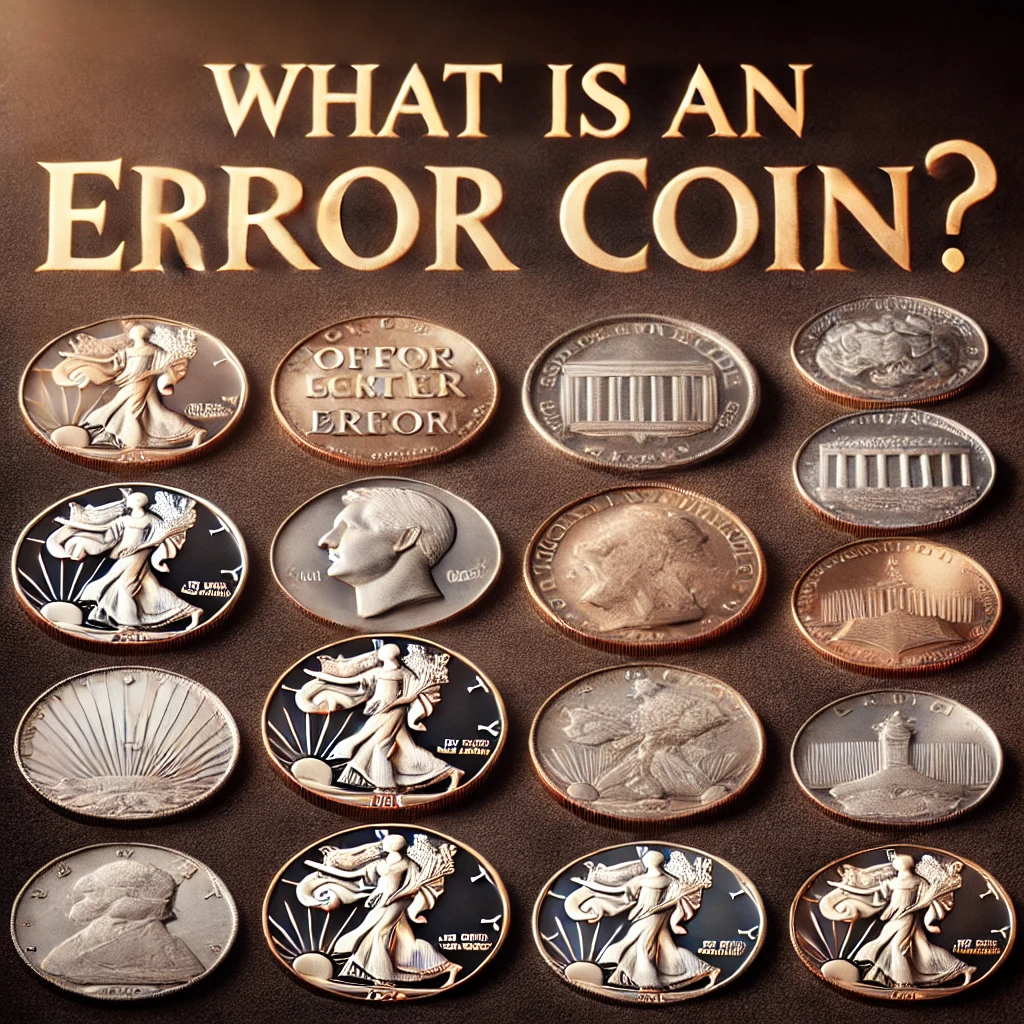
Most coins come out of the mint looking exactly as planned. Every so often, something goes wrong while the coin is being made. The result is an error coin—a coin with a feature caused during production.
Some error coins are easy to spot. Part of the design may be missing, the strike may sit far off center, or the coin may have an unusual shape. Others take a closer look. The challenge is figuring out when the unusual feature happened. A coin damaged after it left the mint can look strange, too, but that damage does not make it a mint error.
This guide will help you understand the main types of error coins and what to check before deciding you have found one.
How Do Error Coins Happen?
A coin begins as a metal blank. It becomes a planchet as it is prepared for striking. At the press, dies stamp the design onto the planchet. A problem with the planchet, the dies, or the strike can leave an error on the finished coin.
That gives collectors three useful places to start when examining an unusual coin:
- Planchet errors involve the metal piece before it receives the design.
- Die errors involve the tools that stamp the design.
- Striking errors happen as the dies strike the planchet.
You do not have to know every technical term to begin collecting. First, look closely at the coin and ask which part of the process could have caused what you see.
Common Types of Error Coins
Off-Center Strikes
An off-center strike happens when a planchet is out of position as the dies strike it. Part of the design appears on the coin, while another part misses the metal entirely. A noticeable blank area often makes this error easy to recognize.
Look at both sides. How much of the design remains? Can you still read the date? Those details help describe the coin accurately.
Clipped Planchets
A clipped planchet has a missing section because the blank was cut incorrectly before striking. Clips can have different shapes, including a curved section along the edge.
A chunk broken or cut from a finished coin can look similar at first. Examine the edge and the way the design meets the missing area before calling it a mint error.
Broadstrikes
The collar normally helps hold a planchet in place and control the coin’s finished diameter. If the collar does not contain the metal during the strike, the coin can spread outward. The result is a broadstrike.
A broadstruck coin may look wider than a normal example and may lack its usual finished edge. Compare it with an ordinary coin of the same denomination and date.
Double Strikes
A double strike occurs when a coin receives a second strike after the first. Depending on how the coin moves, you may see two impressions of the design.
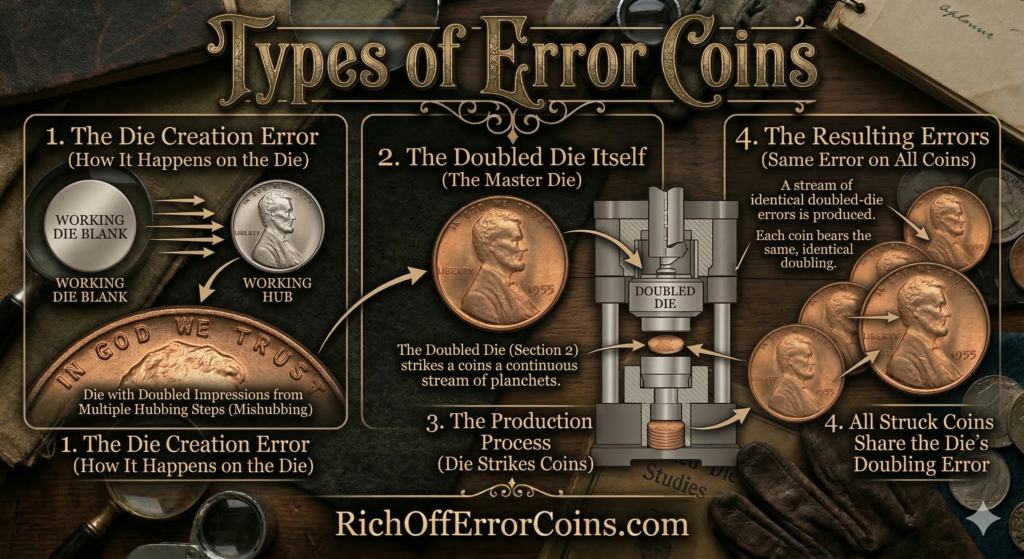
A double strike is different from a doubled die. With a double strike, the coin itself receives more than one strike. With a doubled die, doubling is present on the die and can appear on multiple coins struck by that die.
Struck-Through Errors
Sometimes material gets between a die and a planchet during striking. The material can block part of the design or leave an impression on the coin. Collectors call this a struck-through error.
The appearance depends on what got in the way. That is why a missing or unusual patch of detail needs careful examination before you give it a name.
Error Coin or Post-Mint Damage?
This is one of the most important questions you can ask. Scrapes, cuts, heat, chemicals, and pressure can change a coin after it leaves the mint. Those changes may be dramatic, but they are post-mint damage, often shortened to PMD.
For example, a missing section of a coin could be a clipped planchet—or someone could have cut it away later. A distorted design could point to a minting problem—or damage from machinery outside the mint.
Start by checking both sides, the edge, the surface, and any nearby design details. Then compare your coin with documented examples of the error you suspect. One odd-looking feature alone is rarely enough to identify it with confidence.
Are Doubled Dies Error Coins?
You will often see doubled dies discussed alongside error coins, and many collectors search for both. In precise collecting terms, a doubled die is a die variety. Its distinguishing features can repeat on coins made from the same die. An individual striking error may affect only one coin.
That distinction matters when you look up references. If you suspect a doubled die, compare the specific date, mint mark, design details, and known markers for that variety. A coin that merely looks doubled is not automatically a match.
How to Check a Coin You Think Is an Error
You can make a much better first assessment with a simple, consistent process:
- Identify the coin. Record its denomination, date, and mint mark, if it has one.
- Photograph both sides. Take clear, straight-on pictures in good light.
- Photograph the unusual area. Get a close-up without hiding the rest of the coin’s context.
- Check the edge. The edge can offer clues that face-on photos miss.
- Compare normal examples. Learn what that particular coin is supposed to look like.
- Search for documented matches. Look for the same characteristics, not just a similar nickname or dramatic photo.
Handle the coin by its edges and avoid cleaning it. Cleaning can change the surface and make an already difficult coin harder to evaluate.
Are Error Coins Valuable?
Some error coins attract strong collector interest, while others have little extra value. The type of error, how clearly it shows, the coin’s condition, and demand all matter. A strange appearance does not guarantee a valuable discovery.
Be especially careful with prices you find online. An asking price tells you what someone hopes to receive. It does not tell you what a comparable coin actually sold for. Confirm the identification first, then look at relevant sold examples and professional opinions when the potential value justifies the cost.
Keep Looking Closely
The fun of hunting error coins is that an ordinary handful of change can make you stop and ask, “How did that happen?” Sometimes the answer is a genuine minting mistake. Sometimes it is wear or damage with an interesting story of its own.
Either way, each coin gives you a chance to learn. Start with the date and mint mark, study the unusual feature, and compare what you find with reliable references. The closer you look, the better you get at telling the difference.
Have a coin you are trying to figure out? Explore more guides on Rich Off Error Coins and join the community to share what you found.
Start here
Identify carefully
Document the date, mint mark, denomination, weight, edge, and clear photographs. Separate mint-made characteristics from post-mint damage before estimating value.