This post contains affiliate links. If you buy through them, we may earn a small commission at no extra cost to you. As an Amazon Associate I earn from qualifying purchases.
Every day, millions of Americans exchange loose change at cash registers, self-checkouts, vending machines, and banks without taking a second look. Yet concealed inside bank rolls, change jars, and cash drawers are mechanical anomalies—mint mistakes, die varieties, and planchet mix-ups—that turn ordinary pocket change into collectibles worth hundreds, thousands, or even tens of thousands of dollars.
Finding error coins in circulation worth money is not pure luck; it requires understanding what the U.S. Mint did wrong, what visual markers to spot, and how to tell valuable anomalies apart from mere post-mint damage (PMD).
Before diving into individual coins, it helps to understand the technical boundary between a mechanical mint strike error and a die variety. If you are new to the hobby, check out our foundational guide on Coin Errors and Varieties to master the core terminology.
Below, we break down the 25 most lucrative error coins and die varieties ever discovered in circulation, complete with market values, diagnostic tips, and an actionable roadmap for professional appraisal.
---
The Top 25 Error Coins & Varieties in Circulation
1. 1969-S Lincoln Cent – Doubled Die Obverse (FS-101)
Circulated Value: $15,000 – $35,000
Uncirculated Value: $75,000 – $125,000+
What to Look For: Severe, crisp spread doubling on "LIBERTY" and "IN GOD WE TRUST", as well as the date "1969". Crucially, the "S" mintmark is not doubled because the mintmark was hand-punched into the working die after the hubbing process was complete. If the mintmark is doubled, it is worthless strike machine doubling.
2. 1972 Lincoln Cent – Doubled Die Obverse (FS-101)
Circulated Value: $250 – $450
Uncirculated Value: $600 – $1,200+
What to Look For: Strong, obvious clockwise doubling across all obverse lettering and the date. Unlike minor die doubling varieties of 1972 (there are at least 9 recognized varieties), the master doubled die FS-101 exhibits massive separation on "LIBERTY" with distinct split serifs.
3. 1982 "No P" Roosevelt Dime
Circulated Value: $50 – $120
Uncirculated Value: $200 – $350+
What to Look For: In 1980, the Philadelphia Mint began stamping a "P" mintmark on all denominations except the penny. In late 1982, a die operator failed to punch the "P" mintmark onto an obverse die, producing tens of thousands of dimes missing the mark. Check the right side of Roosevelt's bust above the date: if there is no mintmark, you have a winner.
4. 2004-D Wisconsin State Quarter – Extra Leaf Low & High
Circulated Value: $50 – $150
Uncirculated Value: $250 – $1,500+
What to Look For: Look closely at the ear of corn on the reverse. Two distinct die gouges created an apparent "extra leaf": Extra Leaf Low curves downward toward the cheese wheel, while Extra Leaf High points upward toward the top of the ear. High-grade examples have fetched thousands at major auctions.
5. 1983 Lincoln Cent – Doubled Die Reverse (FS-801)
Circulated Value: $100 – $200
Uncirculated Value: $350 – $600+
What to Look For: Bold doubling on the reverse across "ONE CENT" and "UNITED STATES OF AMERICA". The letters appear visibly thick, with separate shelf-like contours and split serifs.
6. 1995 Lincoln Cent – Doubled Die Obverse (FS-101)
Circulated Value: $15 – $25
Uncirculated Value: $45 – $100+
What to Look For: One of the most common modern circulation finds. Look at the word "LIBERTY" under 10x magnification: the letter "B" and the letters "ER" show clear doubling towards the top.
7. 1992 & 1992-D Lincoln Cent – "Close AM"
Circulated Value: $1,000 – $4,000
Uncirculated Value: $6,000 – $25,000+
What to Look For: In 1992, circulation strikes were supposed to feature the "Wide AM" reverse design, where the "A" and "M" in "AMERICA" are noticeably separated. A tiny batch was accidentally struck using the new 1993 proof reverse die, causing the "A" and "M" to touch at the base.
8. 1998, 1999, & 2000 Lincoln Cent – "Wide AM"
Circulated Value: $10 – $75
Uncirculated Value: $150 – $500+ (1999 is rarest)
What to Look For: The inverse of the 1992 anomaly. Business strikes from 1998–2000 were supposed to have "Close AM" lettering. Due to die substitution, proof reverse dies ("Wide AM") were used on regular circulation strikes. Inspect the spacing between "A" and "M" in "AMERICA".
9. 2005-P "Speared Bison" Jefferson Nickel
Circulated Value: $40 – $100
Uncirculated Value: $250 – $600+
What to Look For: On the reverse of the 2005-P Westward Journey nickel, a dramatic deep die crack runs straight through the back and belly of the American Bison, giving the visual illusion that the animal has been impaled by a spear.
10. 1980 Lincoln Cent – Doubled Die Obverse
Circulated Value: $20 – $50
Uncirculated Value: $100 – $300+
What to Look For: Noticeable doubling on the date "1980" and "LIBERTY". For complete identification markers and auction breakdowns, see our specialized 1980 DDO Penny Guide.
11. 1987-D Repunched Mint Mark Cent (FS-501)
Circulated Value: $5 – $15
Uncirculated Value: $35 – $150+
What to Look For: Secondary outlines of the letter "D" punched visibly south or southwest of the primary mintmark. Read our dedicated 1987 D Over D Penny Value and Identification Guide (FS-501) for microscopic comparison photos.
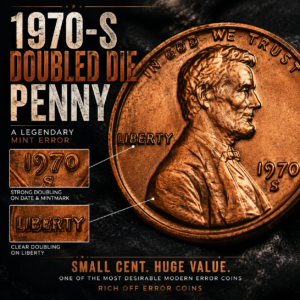
12. 1970-S Lincoln Cent – Doubled Die Obverse (Large Date DDO-001)
Circulated Value: $800 – $2,500
Uncirculated Value: $4,000 – $12,000+
What to Look For: Phenomenal doubling across "IN GOD WE TRUST" and "LIBERTY". Distinct from mechanical doubling by its raised shelf edges. Study the attribution rules in our in-depth 1970 S Doubled Die Penny (DDO-001) Guide.
13. 1965 Silver Roosevelt Dime & Washington Quarter (Transitional Errors)
Circulated Value: $3,000 – $8,000
Uncirculated Value: $12,000 – $20,000+
What to Look For: In 1965, the Mint shifted from 90% silver to copper-nickel clad composition. Leftover 1964 silver blanks fed into the coining presses. If your 1965 dime or quarter shows no copper stripe on the reeded edge, weigh it: a 1965 silver dime weighs 2.50g (vs. 2.27g clad); a silver quarter weighs 6.25g (vs. 5.67g clad).
14. 2000-P Sacagawea Dollar / Washington Quarter Mule
Circulated Value: N/A (Extremely rare)
Uncirculated Value: $100,000 – $190,000+
What to Look For: An authentic "mule" error pairing two incompatible dies: the obverse of a 50 States Washington Quarter struck onto a Sacagawea Dollar golden alloy planchet, paired with the standard flying eagle reverse. Less than two dozen examples are confirmed.
15. 2000-P "Cheerios" Sacagawea Dollar
Circulated Value: $1,500 – $3,000
Uncirculated Value: $4,500 – $10,000+
What to Look For: In 2000, General Mills distributed 5,500 Sacagawea dollars in boxes of Cheerios. A portion featured an early master die with crisp, raised diagonal shaft lines and defined detailing in the tail feathers of the flying eagle on the reverse. Normal dollars have flat, smooth feather shafts.
16. 2007 "Godless" Presidential Dollars (Missing Edge Lettering)
Circulated Value: $15 – $40
Uncirculated Value: $60 – $150+
What to Look For: Presidential dollar coins feature edge lettering with the date, mintmark, and the mottoes "IN GOD WE TRUST" and "E PLURIBUS UNUM". Early batches bypassed the edge-lettering machine entirely, leaving smooth, blank rims.
17. 1943 Bronze Lincoln Cent
Circulated Value: $100,000 – $250,000+
Uncirculated Value: $500,000 – $1,700,000+
What to Look For: In 1943, cents were made of zinc-coated steel to conserve copper for WWII. A handful of bronze planchets remained in tote bins and were struck. Test suspected coins with a strong magnet: if it sticks, it is steel; if it does not stick, weigh it immediately (3.11g bronze vs. 2.7g steel).
18. 1944 Zinc-Coated Steel Cent
Circulated Value: $25,000 – $50,000
Uncirculated Value: $75,000 – $180,000+
What to Look For: When the Mint returned to brass/bronze in 1944, leftover 1943 steel blanks were struck. Unlike the 1943 rarity, this coin will stick to a magnet.
19. 1937-D "3-Legged" Buffalo Nickel
Circulated Value: $400 – $900
Uncirculated Value: $1,800 – $6,000+
What to Look For: Caused by aggressive die polishing to remove clash marks, removing the buffalo's right front leg entirely while leaving the hoof intact. Genuine specimens feature a distinct "moth-eaten" texture on the belly and visible streams of raised die markers.
20. Off-Center Strikes (10% to 50% with Full Date)
Circulated Value: $15 – $75
Uncirculated Value: $80 – $300+
What to Look For: A coin struck when the blank was improperly centered between the dies. To command top dollar, the coin must show a fully visible date and mintmark alongside blank crescent-shaped planchet area.
21. Die Caps and Double Strikes
Circulated Value: $50 – $150
Uncirculated Value: $200 – $1,000+
What to Look For: A die cap occurs when a newly struck coin sticks to the hammer die, repeatedly hammering subsequent planchets and warping into the shape of a metal thimble or bottle cap.
22. Major Clipped Planchets (Curved or Straight)
Circulated Value: $10 – $35
Uncirculated Value: $50 – $150+
What to Look For: When metal strip feeds incorrectly into blanking presses, overlapping punches create crescent or straight-cut missing edges. Genuine clips show the "Blakesley Effect"—weakness or absence of the rim directly opposite the clip.
23. Broadstrikes and Partial Collars
Circulated Value: $15 – $45
Uncirculated Value: $60 – $175+
What to Look For: Struck outside the retaining collar die, allowing the planchet metal to spread outward past standard coin diameter, leaving flat, unreeded rims.
24. Blank Planchets & Type 1 / Type 2 Blanks
Circulated Value: $2 – $8
Uncirculated Value: $10 – $35+
What to Look For: A completely smooth, unstruck coin disc that slipped past the press. Type 1 blanks are flat discs; Type 2 planchets have passed through the upset mill and feature a raised rim.
25. 1955 Lincoln Cent – Doubled Die Obverse
Circulated Value: $1,200 – $2,500
Uncirculated Value: $3,500 – $25,000+
What to Look For: The king of doubled dies. The entire obverse displays unmistakable, dramatic double imagery across "LIBERTY", "IN GOD WE TRUST", and "1955". Millions circulated in northeast vending machines and cigarette packs before collectors caught on.
---
Essential Inspection Tools: How to Screen Your Change
Searching through pocket change and coin rolls requires the right gear. Relying solely on the naked eye or a low-resolution phone camera will cause you to miss valuable die varieties or mistake common mechanical doubling for genuine hub doubling.
Tool Type
Best For
Pros
Cons
Price Range
Triplets Hand Loupe (10x–30x)
Quick pocket checks & coin shows
Compact, portable, distortion-free optical glass
Requires good manual lighting & close eye distance
$15 – $40
Digital USB / LCD Microscope
In-depth variety examination & photography
High magnification (50x–1000x), screen viewing, photo capture
Requires desk space & external power source
$45 – $120
0.01g Digital Precision Scale
Identifying wrong-planchet & alloy errors
Detects silver transitions and non-standard blanks instantly
Needs periodic calibration weights
$15 – $30
Stereo Binocular Microscope
Professional grading & attribution
3D depth perception, zero eye strain, superior optics
Bulky, non-portable, expensive investment
$200 – $600
Collector's Tip: When examining coins for doubled dies, use diffuse, oblique lighting at a 45-degree angle. Direct overhead light washes out the subtle split serifs and shelf-like notches that separate true hub doubling from worthless machine doubling.
---
Step-by-Step Guide: How to Get Your Error Coins Appraised
If you find a coin matching one of the descriptions above, do not run down to the nearest pawn shop. Pawnshops and general antique dealers rarely understand specialized error numismatics and often offer cents on the dollar.
Step 1: Never Clean the Coin
Cleaning any coin—whether with metal polish, dish soap, an eraser, or vinegar—strips the original mint luster and instantly destroys up to 90% of its numismatic value. Leave the coin exactly as found.
Step 2: Safe Storage
Place your find into an acid-free 2x2 cardboard coin flip, a non-PVC plastic capsule, or a vinyl flip. Standard soft plastic sandwich bags and PVC holders contain plasticizers that release acidic green residue (verdigris) over time.
Step 3: Weigh and Measure
Check the physical specifications against standard U.S. Mint parameters using your digital scale. A zinc Lincoln cent should weigh 2.50 grams (±0.10g); a copper cent should weigh 3.11 grams (±0.13g). If a coin's weight is dramatically off-spec, you may have an unrecorded wrong-planchet strike.
Step 4: Seek Preliminary Expert Opinions
Before paying certification fees, post sharp, close-up macro images on respected coin collecting platforms like CoinTalk, the PCGS Collectors Club Forum, or specialized error groups. Experienced numismatists will quickly verify whether your coin displays genuine mint error characteristics or ordinary post-mint damage.
Step 5: Submit for Third-Party Authentication & Grading
For high-value varieties (exceeding $150), submit the coin to a major third-party grading service:
PCGS (Professional Coin Grading Service): The industry standard for varieties and auction liquidity.
NGC (Numismatic Guaranty Company): World-renowned for comprehensive mint error attribution.
ANACS: Highly cost-effective and specialized in attributed die varieties and strike errors.
Certification guarantees authenticity, assigns an official grade on the Sheldon 1–70 scale, protects the coin inside a tamper-proof sonic slab, and commands peak market prices when selling at auction.
---
Free Error Coin Pocket Cheat Sheet
Want a quick, printable reference to keep in your wallet or on your sorting desk? Bookmark this page or download our quick reference guide to keep the exact weights, key dates, and diagnostic zones for all 25 circulation error coins at your fingertips before spending your loose change.
---
Where to find error coins in circulation worth money
Search error coins in circulation worth money on Amazon
Enjoyed this guide? Sign up for our free Rich Off Error Coins email updates to get fresh attribution breakdowns, market alert reports, and practical pocket-change hunting tips delivered straight to your inbox.
 admin
admin