If you have ever found a coin and thought it looked different, possibly even valuable, only to be told that the coin was just damaged... This is where you need to be! This page will help you learn the difference between a true error coin and post mint damage or PMD.
You find a coin that looks completely wrong.
Maybe part of the rim is missing. Maybe there is a strange line through Lincoln’s face. The coin might be bent, stretched, doubled, gouged, copper-colored, unusually thin, or missing part of its design.
Then comes the question almost every error-coin collector has asked at some point:
Is this a real mint error, or is it just damaged?
Knowing the difference between a genuine error coin and post-mint damage (PMD) is one of the most important skills you can develop as a collector. It can keep you from wasting money on damaged coins, prevent you from submitting obvious PMD to a grading company, and make it much easier to recognize a real error when one finally lands in your hands.
The good news is that you do not need to be a professional numismatist to start separating errors from damage.
You need to learn how coins are made, understand how metal behaves during a strike, and train yourself to look for evidence instead of simply looking for something unusual.
Because when it comes to error coins, weird does not automatically mean valuable.
The Most Important Question: When Did It Happen?
If you remember only one thing from this guide, remember this:
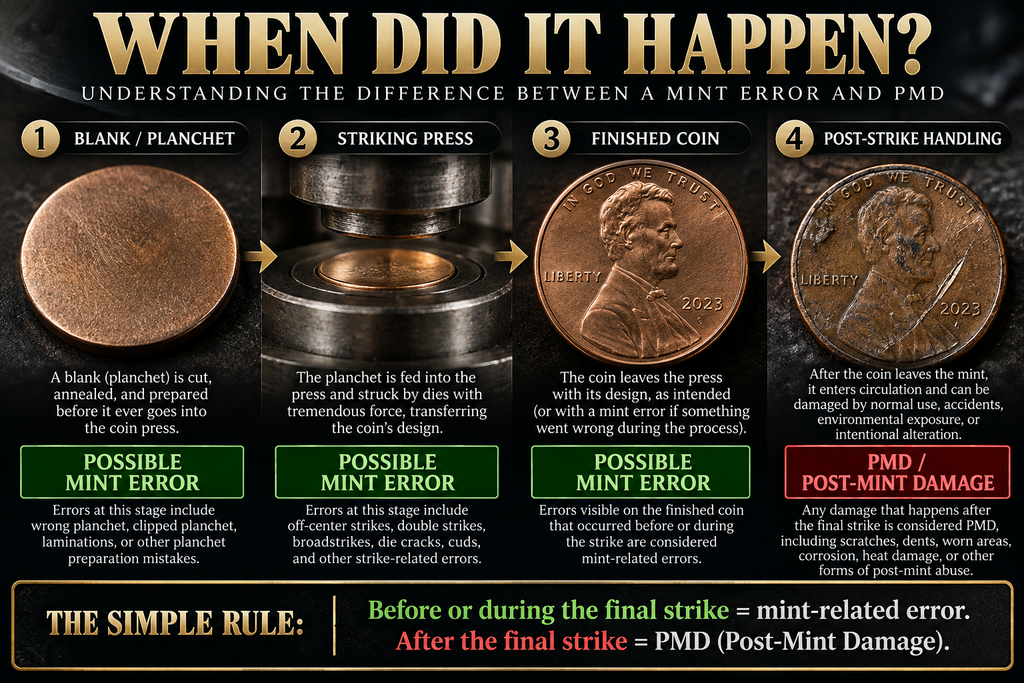
The difference between a mint error and PMD usually comes down to when the abnormality occurred.
A genuine mint error develops during the manufacturing process or during the coin's final strike.
Post-mint damage occurs after that final strike.
PCGS explains this distinction very clearly: something can actually damage a coin inside a U.S. Mint facility and still be considered post-mint damage if the damage happened after the dies delivered the final strike. A coin could get scraped, gouged, or damaged while moving through Mint equipment and still technically show PMD rather than a mint error.
So asking:
“Did this happen at the Mint?”
is not quite the right question.
The better question is:
“Did this happen before or during the final strike, or did it happen afterward?”
That small difference changes everything.
[IMAGE 2 — “WHEN DID IT HAPPEN?” minting-process timeline graphic]
What Is a Mint Error?
A mint error occurs when something goes wrong while a coin is being manufactured.
Collectors generally divide major mint errors into three broad categories: planchet errors, die-related errors, and striking errors. NGC uses these same general categories when explaining how mint errors develop.
A planchet is the piece of metal that gets struck to become a coin.
If something is wrong with that metal before the strike, you may get a planchet error.
If something goes wrong with the dies, the abnormality may transfer onto every coin those dies strike.
If the planchet enters the press incorrectly or something interferes with the strike, you can get a striking error.
Examples include:
- Off-center strikes
- Broadstrikes
- Clipped planchets
- Wrong-planchet errors
- Multiple strikes
- Struck-through errors
- Brockages
- Partial collars
- Missing clad layers
- Major die breaks and cuds
- Split planchets
Each error has its own diagnostics.
That last part is important.
A collector should never identify something as an error simply because it looks unusual. You should be able to explain what happened during the minting process to create it.
What Is Post-Mint Damage?
Post-Mint Damage, or PMD, is damage or alteration that happens after the coin receives its final strike.
Coins take a beating once they leave the press.
They get dropped on concrete.
They get trapped inside washing machines and dryers.
They pass through vending machines, counting equipment, bank rollers, parking meters, and coin sorters.
People drill holes in them.
They hit them with hammers.
They squeeze them in vises.
They scrape them with tools.
They polish them.
They expose them to acids and chemicals.
They grind their edges.
They heat them.
They plate them.
They glue things onto them.
Some people even intentionally alter coins to make them resemble valuable mint errors.
The result can look incredible.
Unfortunately, incredible-looking damage is still damage.
In fact, some of the strangest coins you will ever find in circulation are worth nothing more than face value because everything unusual about them happened after the strike.
Error Coin vs. Post-Mint Damage: The Basic Difference
Here is a useful way to think about it.
| Diagnostic | Genuine Mint Error | Post-Mint Damage |
|---|---|---|
| When it happened | Before or during final strike | After final strike |
| Metal flow | Usually consistent with striking pressure | Frequently interrupted, crushed, scraped, or displaced |
| Design | May form around or over the abnormality | Existing design is often damaged or removed |
| Surface | Abnormality usually fits a known minting process | May show scratches, cuts, dents, tool marks, or corrosion |
| Rim | Often fits the proposed error | May appear hammered, pinched, filed, crushed, or ground |
| Edge | Usually supports the error diagnosis | May show cutting, grinding, squeezing, or impact marks |
| Shape | Explained by the minting process | Often caused by outside physical force |
| Weight | May match a known planchet-related error | Can vary randomly because metal was removed or added |
| Explanation | One minting event can explain the coin | Often requires an outside force after striking |
None of those characteristics should be used alone.
The goal is to collect several pieces of evidence that all point toward the same explanation.
Stop Looking for “Weird.” Start Looking for Evidence.
One of the biggest changes you can make as an error hunter is to stop asking:
“Does this coin look weird?”
Instead ask:
“What process could have created this?”
Anyone can recognize a strange coin.
The skill comes from reconstructing what happened to it.
Imagine yourself working backward through the coin's life.
You know what the coin looks like now.
Your job is to determine whether that appearance came from the minting process or from something that happened afterward.
That means the coin becomes evidence.
Its fields are evidence.
Its design is evidence.
Its rim is evidence.
Its edge is evidence.
Its weight is evidence.
Even the opposite side of the coin can tell you what happened.
Learn to Read Metal Flow
Metal flow is one of the most important concepts in error-coin identification.
When the dies strike a planchet, the metal does not simply receive an image like a printer putting ink on paper.
The metal physically moves.
Under enormous pressure, it flows into recessed areas of the dies and forms the letters, numbers, portrait, rim, and other parts of the design.
That process leaves recognizable characteristics.
PCGS specifically recommends learning how metal flows across a coin's surface because genuine pre-strike defects and post-strike damage tend to affect those flow characteristics differently. PMD often interrupts or distorts surfaces that were already created by the strike.
This gives us one of the best general rules in error collecting:
A genuine mint error usually looks like the abnormality belongs to the strike. PMD often looks like something happened to an already-finished coin.
That sounds simple, but it becomes incredibly powerful once you learn what you are looking at.
Look for Displaced Metal
One major warning sign of PMD is displaced metal.
Imagine hitting a piece of soft metal with the tip of a screwdriver.
The screwdriver creates a depression.
But where does the metal go?
It does not disappear.
Some gets pushed downward. Some moves sideways. Some may rise along the edges of the impact.
That can leave a groove or hole surrounded by raised, rough metal.
The same thing happens when a coin gets smashed, scraped, gouged, or squeezed after minting.
If you find a strange depression, examine the area around it.
Do you see metal piled along the edges?
Are there sharp lips?
Does the surrounding surface look pushed outward?
Can you see scratches leading into or away from the feature?
Does the bottom of the depression expose fresher-looking metal than the surrounding surface?
Those clues often point toward PMD.
Do Not Trust the “Raised Means Error” Rule
You will sometimes hear people say:
“If it is raised, it came from the Mint. If it is recessed, it is damage.”
That rule is far too simple.
Yes, many genuine die-related features are raised.
A die crack is a good example.
If a crack develops inside a die, planchet metal flows into that crack during the strike. The resulting coin can show a raised line.
A major die break can produce a raised area called a cud because metal flows into the space created by the broken portion of the die.
But genuine mint errors can also be recessed.
A struck-through error occurs when foreign material gets between the die and planchet during striking. That material can leave an impression recessed into the coin's surface.
Brockage errors can also produce an incuse, mirrored design when a previously struck coin becomes trapped and acts like a die against another planchet.
At the same time, damage can create raised areas because an impact can push metal upward.
So forget the idea that raised automatically equals mint error.
Look at the entire coin.
Use the Design as a Timeline
One of the best ways to determine when something happened is to study how the coin's design interacts with the suspicious area.
Ask:
Did the abnormality affect the coin before the design was struck, or did something destroy the design afterward?
Suppose a damaged area existed on the planchet before the dies struck it.
The dies may strike letters, numbers, or other design elements across that abnormal area.
The strike becomes the final event.
Now imagine the opposite.
The coin gets struck normally, leaves the press, and then someone hits it with a tool.
That tool damages a design that already existed.
Letters may become flattened.
Details may disappear.
The field may get pushed across the design.
A gouge might cut straight through several already-formed elements.
This gives you a timeline.
Think of it like footprints in wet concrete.
If a crack exists before someone steps into the concrete, the footprint forms across the crack.
If someone breaks the concrete afterward, the damage cuts through the footprint.
Coins can preserve the same sequence of events.
Always Inspect Both Sides
Never diagnose an error using only one side of the coin.
That is especially important when somebody sends you a microscope photo showing one tiny area and nothing else.
Turn the coin over.
A heavy post-mint impact on one side can sometimes distort the opposite side.
Genuine striking errors may also create predictable characteristics on both sides.
An off-center strike, for example, should have geometry that makes sense across the entire coin.
A broadstrike should show characteristics consistent with a coin being struck without the collar properly containing it.
A genuine error tells a complete story.
The obverse, reverse, rim, and edge should not contradict one another.
Do Not Ignore the Edge
The edge might be the most underused diagnostic tool in coin collecting.
People stare at Lincoln's face under 100× magnification while completely ignoring the edge of the coin.
Do the opposite.
Look for grinding.
Look for saw marks.
Look for pinching.
Check whether the reeding suddenly disappears.
Look for folded-over metal.
Examine the thickness.
Search for seams.
Look for sharp areas where someone may have cut the coin.
A damaged edge can instantly destroy an otherwise convincing error theory.
For clipped planchets, broadstrikes, partial collars, wrong planchets, and missing clad layers, the edge can be especially important.
Weigh the Coin
If you collect error coins and do not own an accurate digital scale yet, get one.
Weight can provide extremely useful evidence.
For common modern U.S. specifications, the U.S. Mint lists the following standard weights:
| Coin | Standard Weight | Diameter |
|---|---|---|
| Cent | 2.50 g | 19.05 mm |
| Nickel | 5.00 g | 21.21 mm |
| Dime | 2.268 g | 17.91 mm |
| Quarter | 5.67 g | 24.26 mm |
| Half Dollar | 11.34 g | 30.61 mm |
| Modern Dollar | 8.10 g | 26.49 mm |
These specifications vary for older coin compositions, so always compare your coin with the correct specifications for its date and type.
Weight becomes especially useful with suspected wrong-planchet errors.
NGC documented a Washington quarter struck on a dime planchet that weighed around 2.2 grams. That weight was a major clue because it closely matched the expected weight of the dime planchet rather than a normal quarter.
That is strong evidence.
A quarter that simply looks small is interesting.
A quarter that is small, has missing peripheral design exactly where a dime-sized planchet would end, and weighs approximately what a dime planchet should weigh is much more convincing.
Weight Alone Does Not Prove an Error
Do not make the opposite mistake and treat your scale like a magic error detector.
Coins lose metal through circulation.
Corrosion removes metal.
Grinding removes metal.
Someone may intentionally file a coin down.
Glue, solder, plating, or attached objects can add weight.
Your scale provides one piece of evidence.
Use it alongside diameter, thickness, edge characteristics, design placement, and metal flow.
When several independent measurements support the same explanation, your confidence becomes much stronger.
Use Digital Calipers
A decent pair of digital calipers makes a fantastic companion to your scale.
Measure the diameter.
Measure the thickness.
Compare those measurements with known specifications.
This becomes particularly useful when evaluating suspected wrong planchets, broadstrikes, damaged coins, and unusual planchet errors.
For example, NGC explains that a broadstrike occurs when the coin is struck without the collar properly containing the planchet. Without the collar restricting the metal, the coin spreads beyond its normal diameter.
A larger diameter therefore makes sense.
A coin that has simply been hammered flat might also become wider, but the rest of the evidence will look very different.
Clipped Planchet vs. a Coin That Was Cut
This is one of the classic error coin vs. post-mint damage problems.
A genuine clipped planchet starts before the coin is struck.
Coin blanks are punched from strips of metal. If the blanking punch overlaps an area that was already punched, the next blank can come out missing part of its metal.
That incomplete blank later gets struck.
The important part is that the missing section existed before the final strike.
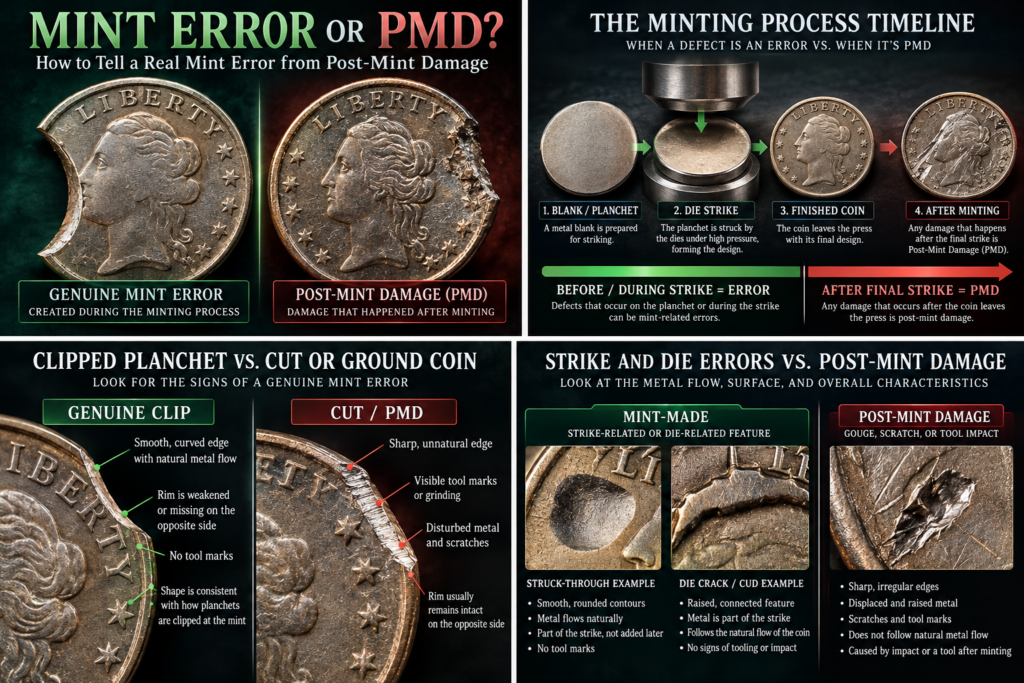
NGC describes genuine clipped planchets this way and documents a useful diagnostic known as the Blakesley Effect.
The Blakesley Effect appears as weakness along the rim roughly opposite the clipped section.
Why?
Because the incomplete blank behaves differently during the upsetting process used to prepare the planchet's rim.
That opposite-side weakness can provide strong evidence that you are looking at a real clipped planchet rather than somebody taking cutting tools to a finished coin.
[IMAGE 3 — GENUINE CLIPPED PLANCHET VS. CUT/GROUND COIN]
Suggested caption:
One of the strongest clues on some genuine clipped planchets is the Blakesley Effect—a weak or incomplete rim opposite the clipped area. A coin that was cut or ground after minting may show sharp tool marks without the corresponding mint-made characteristics.
What Does a Cut Coin Look Like?
Someone can easily take a pair of cutters, grinder, saw, or other tool and remove part of a coin.
From a distance, the result may look like a clipped planchet.
Magnification usually tells a different story.
The cut may reveal parallel grinding marks.
The edge might be unnaturally sharp.
Metal can become folded or pushed sideways.
The rim on the opposite side may remain perfectly normal.
Most importantly, the cut interrupts a coin that had already been completely struck.
Again, follow the timeline.
Off-Center Strike vs. a Damaged Coin
An off-center strike occurs when only part of the planchet sits between the dies during the strike.
Part of the coin receives the design.
The remaining portion stays unstruck.
NGC explains that the planchet may even become elongated depending on how far off center the strike occurs.
A genuine off-center strike should therefore show a logical transition between the struck and unstruck portions.
The design itself should also be missing where the planchet fell outside the dies.
Compare that with a normal coin somebody cut after minting.
The design on the damaged coin was originally centered.
Removing metal afterward does not magically turn that centered strike into an off-center strike.
Look at the strike geometry.
Broadstrike vs. a Smashed Coin
A broadstrike occurs when the collar fails to contain the planchet during striking.
The collar normally helps establish the final diameter and edge characteristics.
Without it, metal can expand outward.
NGC notes one especially useful distinction: a broadstrike retains the complete design on both faces.
If part of the design is missing because the planchet extended beyond the dies, you are dealing with an off-center strike rather than a traditional broadstrike.
Now compare that with a coin that somebody crushed.
A crushed coin may also become wider.
The difference is that the existing design becomes flattened and distorted by the later pressure.
On a genuine broadstrike, the unusual shape developed as the design itself was being created.
That distinction is crucial.
Struck-Through Error vs. Gouge
A struck-through error happens when foreign material gets between the die and planchet during the strike.
The obstruction may be grease, cloth, wire, metal fragments, debris, or another substance.
The dies then strike through the object.
If the material falls away, its shape may remain impressed into the coin.
NGC describes struck-through errors as foreign material interfering with the strike and leaving an impression behind.
A gouge happens afterward.
A tool or another hard object digs into an already-struck coin.
The two can sometimes look surprisingly similar.
The difference comes back to the surrounding metal.
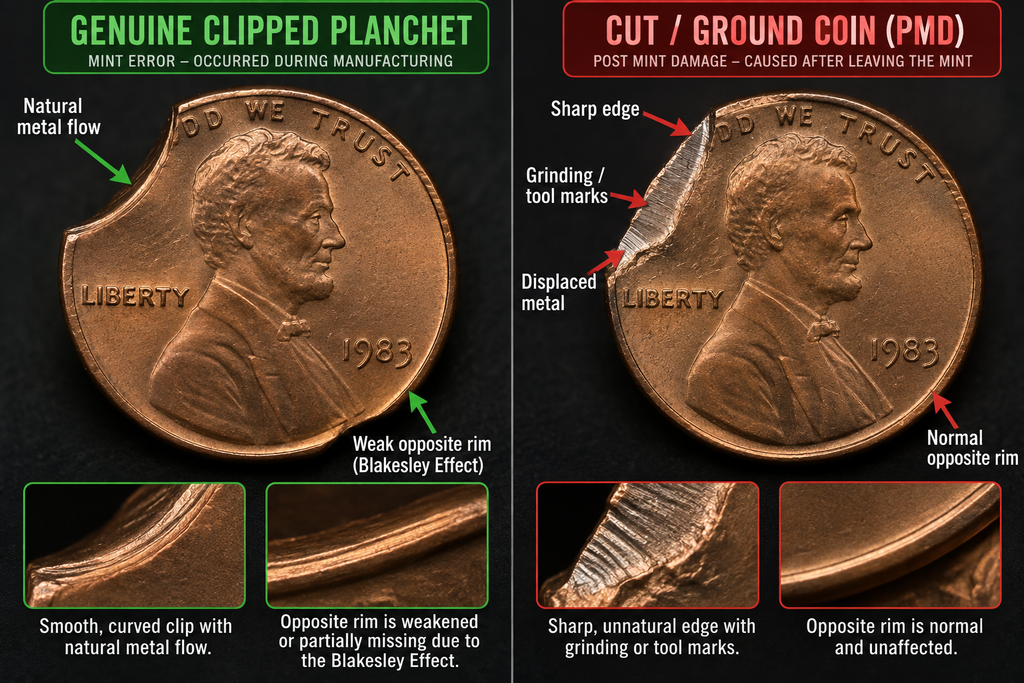
A gouge may show displaced metal, sharp edges, scratches, tearing, or obvious impact characteristics.
A struck-through feature should fit naturally with the strike.
[IMAGE 4 — STRUCK-THROUGH / DIE ERROR VS. GOUGE OR TOOL DAMAGE]
Die Crack vs. Scratch
This comparison is easier once you understand the dies.
A die crack is exactly what it sounds like.
The die develops a crack.
During striking, planchet metal gets forced into that crack.
The feature on the finished coin is therefore normally raised.
A scratch usually cuts into the finished coin and appears recessed.
Large die breaks can create cuds. NGC describes these as raised areas formed when part of the die breaks away and planchet metal flows into the resulting void.
This is where the “raised versus recessed” rule can actually help.
Just remember that it does not apply universally to every type of error.
Missing Clad Layer vs. Chemical Damage
A copper-colored quarter can cause some serious excitement.
Before you start planning what to buy with the auction money, check the coin carefully.
Modern clad coins contain multiple bonded metal layers.
A genuine missing-clad-layer error results from a problem involving one of those layers. The exposed copper core can make one side of the coin appear dramatically different.
NGC notes that coins missing a clad layer may appear copper-colored on the affected side and can show differences in thickness, weight, or strike characteristics.
But plenty of ordinary damage can change a coin's color.
Chemical exposure can do it.
Heat can do it.
Corrosion can do it.
Environmental exposure can do it.
Plating and intentional alterations can do it.
So never identify a missing clad layer based on color alone.
Check the weight.
Inspect the edge.
Look at the surface.
Compare the thickness.
Study how the design interacts with the affected metal.
Make the evidence agree.
Wrong Planchet vs. an Altered Coin
Wrong-planchet errors can be some of the most dramatic and valuable mint mistakes.
They occur when dies strike a planchet intended for another denomination or coin.
That gives collectors several pieces of evidence to work with.
Weight should make sense.
Diameter should make sense.
Metal composition should make sense.
Missing portions of the design should correspond with the smaller or differently shaped planchet.
NGC's example of a Washington quarter struck on a dime planchet illustrates exactly why measurements matter: the coin's roughly 2.2-gram weight strongly supported the dime-planchet diagnosis.
A person trying to fake such an error by grinding a normal quarter down would have to reproduce all of those characteristics.
That is much harder than merely making a coin smaller.
Double Strike vs. the Infamous “Vise Job”
People have been squeezing coins together for a long time.
The result can fool new collectors because one coin may appear to have received another design.
Imagine placing two finished coins face-to-face in a vise and applying tremendous pressure.
The raised design from one coin gets pushed into the other.
That creates an incuse and mirrored impression.
It can look dramatic.
But remember another important warning: an incuse mirrored design does not automatically prove PMD.
A genuine brockage error can also create a mirrored incuse design at the Mint when a previously struck coin remains in the press and acts like a die against the next planchet.
So you must examine the entire coin and determine whether the characteristics match a legitimate brockage or two finished coins being squeezed together.
There are very few useful error-coin rules without exceptions.
That is exactly why understanding the process matters so much.
Doubled Die, Machine Doubling, or Damage?
Another huge source of confusion is doubling.
A doubled die is technically a die variety rather than a random one-off striking error.
The doubling exists on the die itself, which means multiple coins struck by that die can carry the same doubled characteristics.
NGC explains that true doubled dies originate during die production and that the same doubling can transfer onto coins struck from that die.
Machine doubling is different.
It develops during the striking process and often creates flatter, shelf-like doubling.
Then there is plain old damage.
A hit can shift metal.
Scraping can distort letters.
A squeeze can create strange secondary shapes.
This is why every doubled-looking date is not a doubled die.
When hunting varieties, compare suspected coins with known diagnostics for that exact date, mint, and variety.
Lamination or Planchet Problem vs. Corrosion
Planchet metal can contain impurities or weaknesses.
Those problems can cause splitting, cracking, peeling, or separation.
Genuine planchet cracks and split-planchet errors are known and authenticated by major grading companies. NGC explains that impurities or weaknesses inside the planchet can cause it to crack or split under striking pressure.
Unfortunately, environmental damage can also make a coin look like it is peeling apart.
Corrosion may create pits.
Chemicals can attack the surface.
Plated zinc cents can develop bubbles, breaks, and strange-looking surface problems.
That means a flaky surface alone does not prove a planchet error.
Study the structure of the metal.
Does it look like an internal separation?
Or does the surface appear eaten away from the outside?
Once again, reconstruct what happened.
The Rim Can Tell You More Than the Center of the Coin
Collectors naturally focus on portraits, dates, and mintmarks.
Do not forget the rim.
For many errors, the rim is where the best diagnostics live.
A clipped planchet may show the Blakesley Effect.
A partial collar can produce a distinctive stepped or “railroad rim” appearance.
NGC explains that partial-collar errors happen when the planchet sits incorrectly in relation to the collar during striking, allowing some of the metal to expand while another part remains constrained.
Compare that with a coin whose rim was crushed by machinery after minting.
The damaged rim may show obvious squeezing, folding, impact marks, or interrupted design.
The causes are completely different.
Beware of Extreme Magnification
Digital microscopes are useful.
They are also responsible for a ridiculous number of imaginary mint errors.
At 50× or 100× magnification, every coin looks insane.
Tiny contact marks turn into craters.
Normal plating irregularities look like massive geological formations.
Small scratches become trenches.
Die deterioration starts looking mysterious.
Start with the entire coin.
Then inspect the suspicious area.
A 5× or 10× loupe can often tell you more about the overall structure of an error than a microscope zoomed so far in that one letter fills the entire screen.
Context matters.
Compare It With a Normal Coin
One of the cheapest error-identification tools costs exactly face value.
Grab another normal coin of the same type.
Put the two next to each other.
Compare the rims.
Compare the edges.
Look at the lettering.
Study the fields.
Check the normal strike characteristics.
Compare thickness.
Compare diameter.
When you spend enough time studying normal coins, abnormal coins become much easier to recognize.
The collector who studies only alleged errors actually puts himself at a disadvantage.
You need to know what normal looks like first.
Do Not Use Online Asking Prices as Evidence
This deserves its own section.
Someone listing a damaged penny online for $15,000 does not make that penny worth $15,000.
An asking price proves exactly one thing:
Somebody knows how to type a number into a listing.
When researching a suspected error, compare it with authenticated examples from established sources.
Look at PCGS.
Look at NGC.
Study recognized error references.
Check completed auction results for authenticated examples.
Do not validate your coin by finding another questionable coin on the internet with an outrageous price attached to it.
That road gets expensive fast.
Can a Coin Have Both a Mint Error and PMD?
Absolutely.
This is another reason the subject is more complicated than simply putting every coin into one of two boxes.
Imagine a legitimate off-center cent.
It leaves the Mint as a genuine error.
Ten years later, somebody drops it onto concrete.
Then it gets scraped by a machine.
The coin now has both a legitimate off-center strike and post-mint damage.
The later damage does not erase what happened during striking.
However, it can dramatically affect the coin's condition and value.
So sometimes the correct diagnosis is:
Yes, it is a genuine error—and yes, it is also damaged.
Does PMD Ever Make a Coin Valuable?
Usually, no.
Random damage generally reduces numismatic value.
Scratches, holes, gouges, polishing, bending, corrosion, and other forms of damage normally make coins less desirable to collectors.
There are unusual exceptions.
Some altered coins become collectible for historical reasons. Counterstamped coins, love tokens, hobo nickels, historic pieces of jewelry, and other exonumia-related items can develop a collector following of their own.
But that is a different market.
The alteration still does not become a U.S. Mint error simply because someone wants to collect it.
A Practical Error Coin vs. PMD Test
When you find a strange coin, work through the same process every time:
- Do not clean or alter the coin. Do not scratch it, bend it, scrape it, polish it, or try to “remove” anything.
- Identify the exact coin. Determine the denomination, year, mintmark, composition, and normal specifications.
- Look at the entire obverse and reverse. Do this before zooming in.
- Inspect the edge and rim. Search for cutting, grinding, pinching, interrupted reeding, unusual thickness, or metal displacement.
- Use angled lighting. Rotate the coin so light moves across the surface and exposes texture and metal flow.
- Determine the sequence of events. Ask whether the design formed over the abnormality or whether the abnormality destroyed an already-formed design.
- Check for displaced metal. Sharp ridges and pushed-up metal around a depression may indicate impact damage.
- Weigh the coin accurately. Compare the result with the correct specifications for that date and composition.
- Measure diameter and thickness. Use digital calipers when the suspected error involves the planchet, collar, or coin size.
- Identify the proposed minting mechanism. You should be able to explain how the Mint could realistically create the feature.
- Compare it with authenticated examples. Look for the same diagnostics, not simply something that vaguely resembles your coin.
- Seek another opinion before spending serious money. Experienced error collectors, recognized specialists, or professional grading services can help with difficult examples.
That process will eliminate a huge percentage of supposed errors before you ever consider professional grading.
When Should You Send a Suspected Error for Authentication?
Do not submit every weird coin to PCGS or NGC.
Authentication and grading cost money.
First, determine whether you have a strong case.
Professional authentication starts making sense when several independent diagnostics support a recognized error type, the coin could carry enough value to justify certification, or you have something unusual enough that experienced collectors cannot confidently identify it.
Before submitting anything, document it.
Take clear photographs of both sides.
Photograph the edge.
Record the weight.
Measure the diameter and thickness.
And most importantly:
Leave the coin alone.
Do not clean it.
Do not attempt to improve it.
Do not scrape an area because you think something might be covering an error.
The coin itself is the evidence.
Preserve that evidence.
Frequently Asked Questions About Error Coins and PMD
What does PMD mean in coin collecting?
PMD stands for Post-Mint Damage. It refers to damage or alteration that takes place after a coin receives its final strike.
Can a coin be damaged inside the Mint and still be PMD?
Yes.
According to PCGS, damage occurring after the final strike can be classified as post-mint or post-strike damage even when it happens while the coin is still being handled inside a Mint facility.
Does a scratch automatically mean PMD?
An ordinary scratch usually does.
However, not every recessed line or depression is necessarily a scratch. Genuine struck-through errors can create recessed impressions.
Look at the metal and surrounding strike characteristics.
Is a missing chunk of metal automatically a clipped planchet?
No.
Coins get cut, ground, broken, and damaged constantly.
A genuine clipped planchet should display characteristics consistent with the blank being incomplete before striking. Some genuine clips also show the Blakesley Effect on the opposite rim.
Is a copper-colored quarter a missing clad layer?
Not automatically.
Environmental damage, chemicals, heat, plating, and other alterations can change the surface color.
A genuine missing-clad-layer error should have physical characteristics supporting the missing layer rather than color alone.
Are doubled dies mint errors?
They are generally classified as die varieties because the doubling exists on the die and repeats on coins produced from that die.
Can a genuine error also have PMD?
Yes.
A genuine error coin can become scratched, corroded, bent, or otherwise damaged after leaving the press.
Is every broad, flat coin a broadstrike?
No.
A genuine broadstrike results from the coin being struck without the collar properly containing the planchet. NGC notes that a true broadstrike retains the complete design on both faces.
What tools should an error-coin collector own?
You can identify a surprising amount with good lighting, a quality loupe, a digital scale accurate to at least 0.01 gram, digital calipers, and a camera capable of taking clear close-up photographs.
The most important tool, however, is understanding how the coin was made.
The Bottom Line: Make the Coin Prove It
Finding a weird-looking coin is easy.
Figuring out why it looks weird is where real error collecting begins.
Do not call something a mint error because it looks different.
Do not call it an error because somebody online told you it was one.
Do not call it an error because another person listed something similar for $10,000.
And definitely do not assume that every strange-looking penny is going to pay off your mortgage.
Make the coin prove what happened.
Follow the metal.
Study the surface.
Check the rim.
Inspect the edge.
Look at both sides.
Measure it.
Weigh it.
Compare it with a normal example.
Then compare it with authenticated examples of the error you believe you found.
Finally, ask the most important question:
Can the minting process realistically explain everything I see on this coin?
If the answer is yes and the physical evidence supports that explanation, you may have found a genuine mint error.
If the evidence shows cutting, scraping, squeezing, crushing, grinding, corrosion, chemical alteration, tool marks, or some other event that occurred after the strike, you are probably looking at PMD.
Learning this difference will save you money.
It will save you from submitting damaged coins for grading.
It will keep questionable online listings from fooling you.
Most importantly, it will make you a better error hunter.
Eventually, you stop seeing every damaged coin as a possible jackpot.
Instead, you start noticing something much more exciting:
the real errors hiding in plain sight.