1992 Close AM Penny: Value, Rarity & How to Identify the Rare 1992 and 1992-D Cents
 admin
adminWhat if one of the most valuable modern Lincoln cents looked almost exactly like an ordinary penny?
That is exactly what makes the 1992 Close AM penny so interesting.
At first glance, there is nothing dramatic about it. The date looks normal. Lincoln looks normal. There is no obvious doubled lettering, missing mintmark, giant crack, or off-center strike.
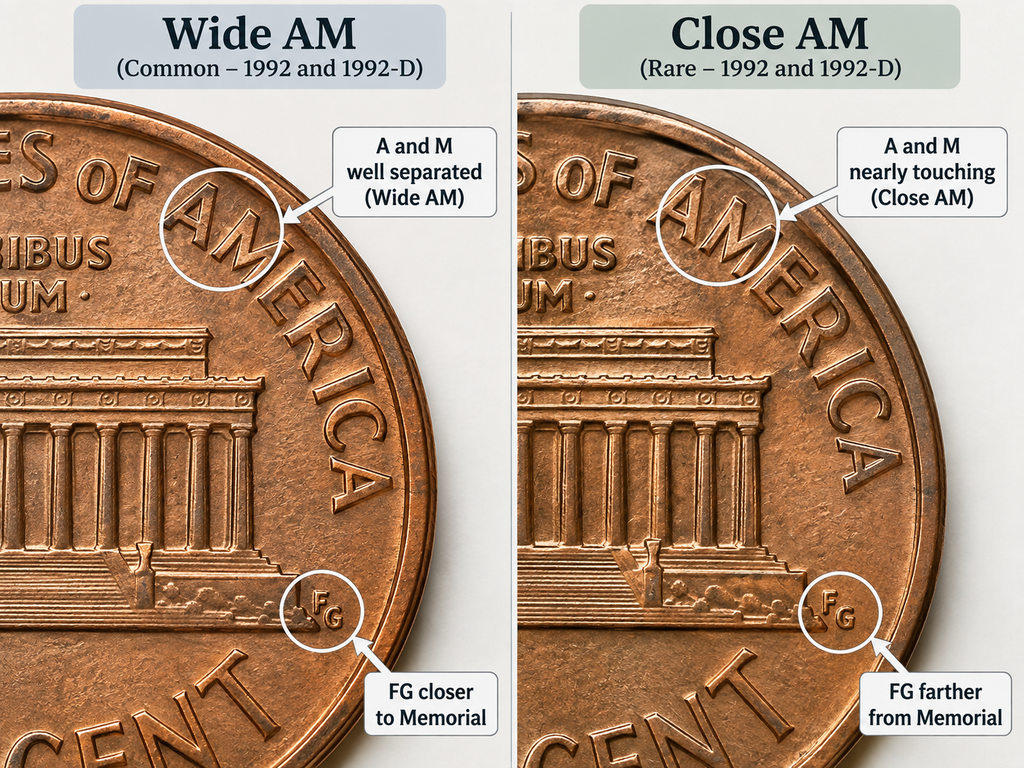
The feature that separates a common 1992 penny from an extremely rare variety appears on the reverse. Look closely at the word AMERICA, specifically the letters A and M.
On a normal 1992 penny, those letters have a noticeable space between them. On the rare 1992 Close AM penny, the bottoms of the A and M sit extremely close together.
That tiny difference can separate a one-cent coin from a Lincoln cent worth hundreds, thousands, or potentially tens of thousands of dollars.
Even better for coin hunters, the variety exists on both the 1992 penny with no mintmark and the 1992-D penny.
What Is a 1992 Close AM Penny?
The 1992 Close AM penny is a rare Lincoln Memorial cent struck with a reverse design that was intended for use on later Lincoln cents.
Most business-strike Lincoln cents dated 1992 used what collectors call the Wide AM reverse. On those coins, the bottom of the A and M in AMERICA have a clearly visible gap.
The Mint introduced a redesigned reverse for circulation cents beginning in 1993. One of the easiest ways to recognize that newer reverse is the much tighter spacing between the A and M.
Somehow, a small number of 1992-dated cents were struck with this newer reverse.
Collectors have discovered them from both Philadelphia and Denver.
PCGS describes the coins as a transitional variety created when reverse dies intended for the newer design were paired with 1992 obverse dies.
That makes the 1992 Close AM much more than a tiny lettering oddity. It represents a physical connection between two different design generations of the Lincoln cent.
1992 Close AM vs. Wide AM
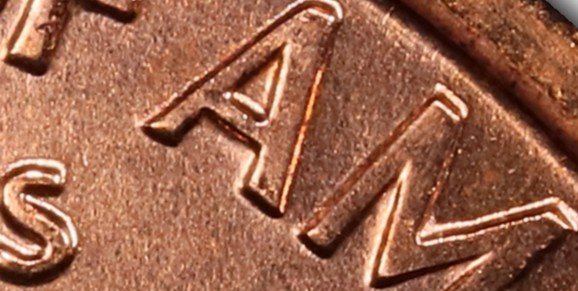
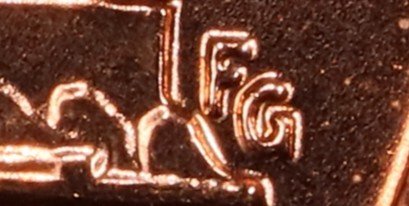
This is a REGULAR 1992 Penny that is NOT VALUABLE
Fortunately, you do not need an expensive microscope to perform the first test.
Flip the penny over.
Find AMERICA above the Lincoln Memorial and focus on the bottom of the A and M.
A normal 1992 Wide AM shows obvious separation between the letters. The rare Close AM has a very narrow space between them. At first glance, they can even appear to touch.
However, do not immediately assume that every 1992 penny with close-looking letters is valuable.
Wear, corrosion, lighting, camera angles, circulation damage, and die deterioration can make the spacing difficult to judge.
There is a second diagnostic that serious collectors should always check.
Check the FG Initials Before Celebrating
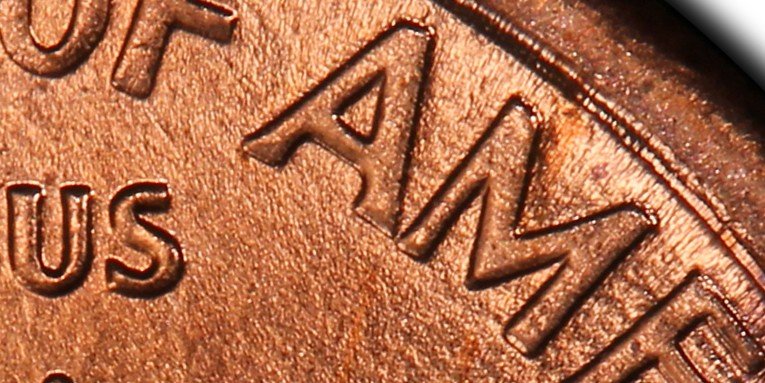
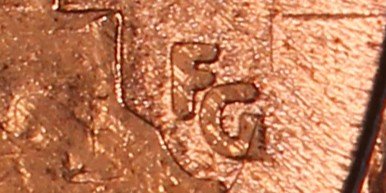
$$$ This is the 1992 Close AM Penny worth thousands of dollars $$$
Look to the lower-right side of the Lincoln Memorial.
You will find the initials FG, representing Lincoln Memorial reverse designer Frank Gasparro.
On the Close AM reverse, the FG initials sit farther away from the Memorial. On the common Wide AM reverse, the initials sit closer to the building.
Lincoln Cent Resource specifically recommends using the FG initials as a confirmation because deteriorating dies can sometimes make the AM spacing misleading. The site summarizes the relationship nicely: a Close AM has more widely spaced FG initials, while a Wide AM has FG initials positioned closer to the Memorial.
That means you should check both features before assuming you found the rare variety.
| Diagnostic | Normal 1992 Wide AM | Rare 1992 Close AM |
|---|---|---|
| A and M in AMERICA | Clearly separated | Extremely close or nearly touching |
| FG position | Closer to Memorial | Farther from Memorial |
| Reverse style | Standard 1992 reverse | Reverse design introduced for 1993 |
| Availability | Extremely common | Extremely rare |
| Collector interest | Low in circulated grades | Very high |
If both diagnostics match the Close AM design, stop tossing the coin around with the rest of your change. You may have found something worth authenticating.
The 1992 Close AM Penny With No Mintmark
A 1992 penny without a mintmark was produced at the Philadelphia Mint.
Philadelphia struck an enormous 4,648,905,000 Lincoln cents in 1992, according to PCGS. The regular coins weigh approximately 2.50 grams, measure 19 millimeters in diameter, and use a copper-plated zinc composition.
Almost all of those billions of cents have the normal Wide AM reverse.
The rare Philadelphia Close AM is a completely different story.
PCGS identifies the 1992 Philadelphia Close AM as the scarcer of the two 1992 varieties. Earlier PCGS research reported fewer than 20 examples certified across the different color designations at the time that article appeared.
Because new examples can appear and grading populations change, you should not treat an old population figure as a permanent census. The important point remains the same: the Philadelphia 1992 Close AM is exceptionally scarce.
The Philadelphia variety was discovered after the Denver version. Numismatic references trace its discovery to collector Parker Ogilvie in 2006.
So when checking 1992 pennies, never ignore the ones without a mintmark.
They may actually be the ones you want most.
The Rare 1992-D Close AM Penny
Denver produced even more than four billion Lincoln cents during 1992.
PCGS lists the Denver mintage at 4,448,673,300 coins. Like the Philadelphia issue, nearly all of them carry the normal Wide AM reverse.
The rare exception is the 1992-D Close AM penny, commonly attributed as FS-901.
Collector Colin Kusch discovered the first recognized 1992-D Close AM in December 2001. PCGS also reports that another die pairing was discovered by collector Greg Smith in 2017.
That second die pairing is especially interesting because it shows that the variety was not necessarily produced by one single accidental die pairing.
The Denver variety remains extremely scarce, although it appears more frequently than its Philadelphia counterpart.
Current PCGS information says that more than 100 examples of the 1992-D Close AM have been discovered, with many of the certified coins falling around the AU50 to AU58 range.
That is still microscopic compared with a Denver mintage of more than 4.4 billion cents.
Why Does the 1992 Close AM Exist?
This is where the story gets interesting.
The United States Mint was changing the Lincoln cent reverse design around this period. The newer design brought the A and M in AMERICA much closer together.
That Close AM reverse became normal on 1993 circulation cents.
Yet examples of that reverse somehow appeared on cents dated one year earlier.
PCGS has suggested that some of the coins could have resulted from test or experimental strikes associated with the upcoming reverse design. The exact circumstances may never be known with complete certainty.
What collectors can verify is the physical evidence.
A 1992 obverse was paired with the newer reverse design.
That combination created one of the most famous modern Lincoln cent varieties.
Is the 1992 Close AM an Error Coin or a Variety?
You will see the 1992 Close AM called an error penny all over the internet.
That description helps beginners find the coin, but it is not the most precise numismatic terminology.
The Close AM feature came from the design of the die itself. The Mint did not accidentally move the letters during the strike. Instead, a different reverse design was used with a 1992-dated obverse.
For that reason, collectors commonly describe it as a transitional variety, transitional reverse, or die variety.
PCGS lists the Close AM coins as major varieties and recognizes FS-901 attribution for the die variety. Lincoln Cent Resource also classifies the 1992-D Close AM as FS-901.
So, while “1992 Close AM error penny” is a popular search phrase, “1992 Close AM transitional variety” describes what happened more accurately.
How Rare Is the 1992 Close AM Penny?
Extremely rare.
But there is an important distinction between the two mints.
The 1992 Philadelphia Close AM is substantially scarcer, while more examples of the 1992-D Close AM have surfaced.
That does not make the Denver coin common. Not even close.
PCGS currently describes the Denver issue as remarkably scarce and reports just over 100 discovered examples. Compare that number with more than 4.4 billion ordinary Denver cents produced that year.
The Philadelphia version has historically appeared in much smaller numbers.
This extreme rarity explains why even circulated examples attract serious collector attention.
1992 Close AM Penny Value
There is no single value that applies to every 1992 Close AM penny.
Grade matters tremendously.
Color also matters on Lincoln cents. Grading companies may classify uncirculated copper-colored cents as BN (Brown), RB (Red-Brown), or RD (Red). Original red examples generally command stronger prices when other factors remain equal.
Most importantly, authentication matters.
A raw coin listed online for an outrageous asking price does not establish its actual market value.
Real completed auction results provide much stronger evidence.
A PCGS-graded 1992 Philadelphia Close AM MS67RD sold for $25,850 at Heritage Auctions in January 2017. That sale remains one of the best-known auction records for the variety.
More recently, a 1992 Philadelphia Close AM graded AU55 by PCGS sold for $9,600 through Heritage Auctions in November 2023, according to Greysheet's auction records.
The Denver coin has also produced impressive results.
A famous 1992-D Close AM graded PCGS MS64 Red-Brown sold for $20,700 in 2012. Coin World documented that sale and identified the coin as a transitional piece struck with the newer reverse.
More recent transactions show how widely prices can vary by grade and color. A 1992-D Close AM graded NGC MS64 Brown sold for $2,640 in November 2025. An NGC MS62 Red example sold for $1,708 on August 31, 2026.
Those results demonstrate why internet statements such as “every Close AM is worth $25,000” are misleading.
Some examples have reached five figures. Others trade for four figures. Problem coins or lower-grade pieces can sell for substantially less.
The grade, color, eye appeal, grading service, certification, and current collector demand all influence the final price.
What Is a Normal 1992 Penny Worth?
This distinction matters because billions of ordinary 1992 cents exist.
Finding a 1992 penny does not automatically mean you found something rare.
A normal circulated 1992 or 1992-D Wide AM cent generally carries little premium over face value. High-grade examples can have collector value, but that is a completely different market from the Close AM variety.
The money is in correctly identifying the reverse.
That is why checking the AM and FG diagnostics should come before researching auction prices.
Can You Find a 1992 Close AM Penny in Circulation?
Yes.
That possibility is one reason this variety has become so popular with modern coin hunters.
Unlike a nineteenth-century rarity that disappeared from circulation generations ago, these coins came from massive 1992 cent production runs and entered the same channels as ordinary pocket change.
The Denver discovery itself happened years after the coins were produced. The Philadelphia variety took even longer to receive recognition.
Collectors continue searching bank rolls, old change jars, inherited collections, coin-counting machine rejects, dealer bulk bins, and boxes of Lincoln cents.
The odds are obviously tiny.
Still, the cost of checking is almost nothing.
That makes the 1992 Close AM one of those varieties that can turn an ordinary roll-searching session into a serious discovery.
Be Careful With Altered 1992 Close AM Pennies
The value of genuine examples creates another problem: counterfeits and alterations.
Coin World has documented a deceptive fake made by combining parts of a normal 1992 cent with the reverse of a later Close AM cent.
In that altered example, investigators could detect a seam where the pieces had been joined. Coin World recommends closely inspecting suspicious coins around the rim and edge for evidence of alteration.
This is exactly why authentication matters when thousands of dollars could be involved.
A genuine-looking AM spacing alone does not prove the coin is genuine.
What Should You Do If You Find One?
First, do not clean the coin.
Cleaning can permanently damage the surface and dramatically reduce collector value.
Next, photograph the entire obverse and reverse under good lighting. Then take sharp close-up images of the AM in AMERICA and the FG initials beside the Memorial.
Compare the coin against verified examples rather than random marketplace listings.
If both primary diagnostics match, consider submitting the coin to a respected third-party grading service such as PCGS or NGC.
A genuine 1992 Close AM carries enough potential value that professional authentication can make sense even on a circulated example.
Until you know what you have, handle the coin carefully by its edges and place it in an inert coin holder.
What Magnification Do You Need?
You do not need laboratory equipment.
A basic 5× to 10× loupe can usually show the AM spacing clearly.
A digital microscope makes the comparison even easier, especially when checking FG placement and photographing a suspected variety.
Do not fall into the trap of using extreme magnification immediately.
Start with the overall reverse. Confirm the AM spacing. Then inspect the FG initials.
The major diagnostics should agree with each other.
An Easy Comparison Trick
If you are new to Close AM varieties, grab a normal 1993 penny.
The Close AM reverse became standard for circulation strikes in 1993, making a regular 1993 cent a useful visual reference for the general appearance of the A and M spacing.
Then compare it with an ordinary 1992.
The difference becomes much easier to recognize once you have both reverse styles sitting beside each other.
Lincoln Cent Resource recommends similar date comparisons when learning how to distinguish the two reverse designs.
Once your eye learns the difference, searching rolls becomes much faster.
Why the 1992 Close AM Penny Is Such an Incredible Coin to Hunt
Some valuable coins announce themselves immediately.
The 1992 Close AM does the opposite.
It hides behind one of the most ordinary dates imaginable.
Billions of 1992 pennies were produced. Most people would never think twice before tossing one into a jar, spending it, or feeding it into a coin-counting machine.
Yet a tiny percentage were struck with the wrong reverse design for the year.
That is what makes searching for the 1992 Close AM penny so addictive.
You are not looking for a rare date.
You are looking for a rare design hiding inside an extremely common date.
And the difference comes down to two letters.
Frequently Asked Questions About the 1992 Close AM Penny
How can I tell if my 1992 penny is a Close AM?
Look at the reverse and examine the A and M in AMERICA. The rare Close AM has almost no space between the bottoms of those letters. Then check the FG initials beside the Lincoln Memorial. On the Close AM reverse, FG sits farther away from the building.
Is a 1992 penny with no mintmark valuable?
Most are common. However, a genuine 1992 Philadelphia Close AM penny is extremely rare and can be worth thousands of dollars depending on its grade and condition.
Is the 1992-D Close AM penny rare?
Yes. Although it is more frequently encountered than the Philadelphia variety, PCGS still describes the 1992-D Close AM as remarkably scarce.
How much is a 1992 Close AM penny worth?
Values vary significantly. Certified examples have sold from the hundreds or low thousands into five figures depending on grade, color, condition, and mint. A Philadelphia MS67RD example sold for $25,850 in 2017, while a PCGS AU55 Philadelphia example sold for $9,600 in 2023.
How much is a 1992-D Close AM penny worth?
Certified Denver examples frequently trade in the four-figure range, although values vary considerably by grade and color. An NGC MS62 Red example sold for $1,708 in August 2026, while exceptional examples have historically sold for much more.
Is the 1992 Close AM actually an error?
Collectors often call it an error penny, but transitional variety is more precise. The coin was struck using a different reverse design than normally expected for 1992.
Which is rarer: the 1992 or 1992-D Close AM?
The 1992 Philadelphia Close AM is considered the rarer variety. PCGS population information and specialist references consistently place it above the Denver issue in rarity.
Does the A actually touch the M on a Close AM?
Not necessarily. The letters can appear to touch, but a tiny space may remain. That is why the FG initials provide such an important second diagnostic.
Final Thoughts
The 1992 Close AM penny proves that you do not need a 100-year-old coin to make an incredible discovery.
Sometimes the difference between an ordinary penny and a major modern rarity is sitting in plain sight.
For 1992 and 1992-D Lincoln cents, turn the coin over and check AMERICA. Look for an A and M that nearly touch. Then move down to the FG initials and confirm that they sit farther away from the Lincoln Memorial.
If both features match, do not clean the coin and do not assume an online listing tells you what it is worth.
Get it authenticated.
A genuine 1992 or 1992-D Close AM penny is one of the most exciting Lincoln cent varieties you can realistically search for in modern change.
The next time a 1992 penny lands in your hand, don't look at Lincoln first.
Flip it over.
Those two little letters might be hiding something big.