This post contains affiliate links. If you buy through them, we may earn a small commission at no extra cost to you. As an Amazon Associate I earn from qualifying purchases.
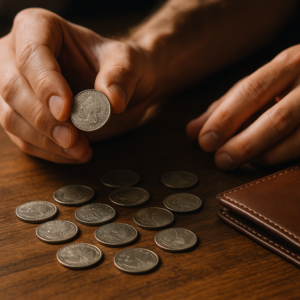
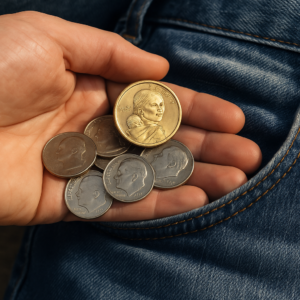
Every day, millions of dollars in loose coins change hands across drive-thrus, grocery checkout lanes, and vending machines. Most people toss that spare change into a cup in their car console or dump it unceremoniously into a coin-counting kiosk for a fee.
If you do that without looking, you might literally be throwing away hundreds—or even thousands—of dollars.
Finding rare coins worth money in pocket change isn't a fairy tale reserved for vintage estate auctions or deep-pocketed investors. Modern dies crack, mint workers misplace dies, planchet metal compositions accidentally shift, and historic silver slips back into circulation unnoticed.
Before you spend another piece of loose change, take a breath, grab a loupe, and check your pocket change against this 12-coin field guide.
---
Essential Tools Every Pocket Change Hunter Needs
Before diving into the checklist, you don't need a professional laboratory to spot real treasures, but you do need two simple tools:
1. A 10x to 30x Jeweler's Loupe or Pocket Digital Microscope: Tiny die doubling, repunched mint marks, and hairline die cracks are impossible to verify reliably with the naked eye. Learn how to tell if you have a doubled die penny properly by checking for crisp spread and notching rather than flat strike shelf doubling.
2. A Pocket Gram Scale (0.01g precision): Weighing coins is the only foolproof way to detect wrong-planchet transition errors, such as copper cents struck on post-1982 zinc planchets (or vice-versa).
3. Proper Handling Knowledge: Never clean your coins. Even light wiping with a cloth or cleaning with mild soap destroys the original surface luster, stripping away up to 90% of a coin's numismatic premium instantly.
---
12 Rare Coins in Pocket Change Worth Real Money
1. 1982-D Small Date Bronze (Copper) Cent
Estimated Value: $5,000 to $20,000+ (depending on grade)
What to Look For: In 1982, the U.S. Mint transitioned the Lincoln cent from a 95% copper composition to a 97.5% zinc core with a thin copper plating. They also produced two distinct date styles: "Large Date" and "Small Date." While Philadelphia struck both variations in copper and zinc, the Denver Mint officially struck the Small Date only in zinc. However, a tiny handful of 1982-D Small Date cents struck on solid bronze planchets slipped out.
The Test: Drop it on a digital scale. Standard zinc cents weigh 2.50 grams, while a genuine 1982-D Small Date copper cent weighs 3.11 grams. On the Small Date variety, the "8" features a noticeably smaller upper loop, and the "2" has a delicate, sweeping curve.
2. 2004-D Wisconsin State Quarter "Extra Leaf" (High & Low)
Estimated Value: $50 to $500+
What to Look For: On the reverse of the 2004-D Wisconsin 50 State Quarter, an ear of corn stands alongside a wheel of cheese. Look closely at the lower-left section of the corn stalk. You might spot an extra curved line that resembles an additional husk leaf. Two distinct varieties exist: "Extra Leaf High" (where the leaf curves upward toward the main corn stalk) and "Extra Leaf Low" (where the leaf rests lower against the rim). Both are prime examples of modern quarter errors worth money.
3. 1969-S Lincoln Cent Doubled Die Obverse (FS-101)
Estimated Value: $25,000 to $100,000+
What to Look For: This is the holy grail of modern Lincoln pennies. A genuine 1969-S Doubled Die Obverse displays strong, prominent spread doubling on the obverse inscriptions "LIBERTY" and "IN GOD WE TRUST," as well as on the date "1969."
Crucial Diagnostic: The "S" mint mark was punched by hand into the die after the hubbing process was complete. Therefore, on a genuine doubled die, the "S" mint mark will be sharp and single—it will never be doubled. If the mint mark is doubled, it is flat mechanical machine doubling with no premium.
4. 2019 & 2020 "W" Mint Mark National Park Quarters
Estimated Value: $10 to $30 (Circulated) | $50+ (Uncirculated)
What to Look For: For over two centuries, the West Point Mint reserved its "W" mint mark almost exclusively for bullion and commemorative proofs. But in 2019 and 2020, the Mint shocked collectors by releasing exactly 2 million "W" quarters for each design directly into circulating coin bags mixed at regional distribution banks.
How to Spot It: Look to the right of George Washington's portrait. If you see a crisp "W" instead of a "P" or "D," set it aside immediately. In 2020, these coins also feature a small "V75" privy mark on the left obverse to commemorate the 75th anniversary of the Allied victory in World War II.
5. 1992 "Close AM" Lincoln Cent
Estimated Value: $500 to $4,000+
What to Look For: On normal 1992 cents, the "A" and "M" in "AMERICA" on the reverse sit visibly separated. However, a small batch of 1992 Philadelphia and 1992-D Denver dies mistakenly received the newly designed 1993 reverse die early. On this "Close AM" variety, the bottom right leg of the "A" and bottom left leg of the "M" are practically touching or merged together. Additionally, the designer's initials "FG" sit noticeably farther away from the Lincoln Memorial building base.
6. 1999 "Wide AM" Lincoln Cent
Estimated Value: $100 to $400+
What to Look For: The direct inverse of the 1992 variety! By 1999, business-strike circulation pennies were supposed to use the "Close AM" design. However, mint workers inadvertently paired some regular 1999 circulation dies with proof reverse dies ("Wide AM"). Look at the reverse of any 1999 Philadelphia penny: if there is a distinct gap between the "A" and "M" in "AMERICA," and the "FG" initials are nestled right up against the Memorial building, you have a valuable variety.
7. 1982 "No P" Roosevelt Dime
Estimated Value: $150 to $300+
What to Look For: Beginning in 1980, the Philadelphia Mint started adding a "P" mint mark to Roosevelt dimes. In late 1982, a die operator failed to punch the mint mark onto a working die, resulting in tens of thousands of dimes entering circulation with no mint mark above the date. Look closely at the obverse right side just above the "1982" date; if the area is blank, it's the coveted "No P" dime.
8. Pre-1965 90% Silver Coins (Dimes, Quarters, Halves)
Estimated Value: 15x to 22x face value minimum (bullion spot dependent)
What to Look For: You don't need a microscope to find these. Any Roosevelt dime, Washington quarter, or Franklin/Kennedy half dollar dated 1964 or earlier is composed of 90% pure silver and 10% copper.
The Edge Test: Check the reeded rim of the coin. Modern clad coins display a distinct copper-brown stripe running along the center. Silver coins show a solid, bright white-silver rim with no copper layer visible. Review our guide to pre-1965 silver coins in pocket change for step-by-step roll-hunting techniques.
9. 1983 Lincoln Cent Reverse Doubled Die (DDR-001)
Estimated Value: $150 to $400+
What to Look For: Under magnification, turn a 1983 cent over to its reverse. Inspect the words "ONE CENT" and "UNITED STATES OF AMERICA." On the DDR-001 variety, the lettering displays striking, massive doubling toward the rim. The word "CENT" exhibits distinct thickness and split serifs, making it one of the most prominent doubled dies discovered in modern times.
10. 2005-P Kansas State Quarter "In God We Rust"
Estimated Value: $30 to $100+
What to Look For: This famous "grease strike" error occurred when heavy machine grease clogged the recessed "T" in "IN GOD WE TRUST" on the obverse die. The struck coin reads clearly: "IN GOD WE RUST." While minor grease strikes carry small premiums, this particular error captured mainstream attention and remains a hot collector favorite among error coins in circulation.
11. 1972 Lincoln Cent Doubled Die Obverse (FS-101)
Estimated Value: $250 to $1,000+
What to Look For: 1972 produced multiple obverse doubled dies, but Die #1 (FS-101) is the premier prize. Check the date "1972," the motto "IN GOD WE TRUST," and "LIBERTY." All three inscriptions feature dramatic separation doubling directed toward the southwest. Unlike master die doubling (which is common and carries no value), FS-101 shows clean separation and sharp notches on the letters "L" and "I" in LIBERTY.
12. 1995 Lincoln Cent Doubled Die Obverse (DDO-001)
Estimated Value: $20 to $75+
What to Look For: For a coin struck decades after modern hub tooling improvements, the 1995 DDO penny is surprisingly easy to spot. Look at the word "LIBERTY" on the obverse: the doubling on "BERTY" is thick, bold, and distinct. The motto "IN GOD WE TRUST" also shows crisp shelf-free doubling on the letters. Because millions of these were minted, they still regularly surface in bank-wrapped rolls.
---
Quick Comparison: Pocket Change Rarities at a Glance
Coin & Variety
Key Diagnostic Marker
Circulation Test Method
Typical Market Value
1982-D Small Date Bronze
Delicate "2" curve; small upper loop "8"
Digital Scale: Must weigh 3.11g
$5,000 – $20,000+
1969-S DDO (FS-101)
Bold doubling on date & motto; single "S"
10x–20x Jeweler's Loupe
$25,000 – $100,000+
1992 Close AM Cent
"A" and "M" in AMERICA nearly touching
10x Loupe (Reverse check)
$500 – $4,000+
1999 Wide AM Cent
Distinct visible space between "A" and "M"
10x Loupe (Reverse check)
$100 – $400+
2004-D Wisconsin Quarter
Extra vertical leaf next to corn stalk
Visual inspection / 5x Loupe
$50 – $500+
2019 / 2020 "W" Quarters
"W" mint mark on George Washington obverse
Naked eye check
$10 – $30+
1982 No Mint Mark Dime
No "P" mint mark above date on obverse
Naked eye / 5x Loupe
$150 – $300+
Pre-1965 Silver Coins
Solid silver edge without copper core band
Edge check / 1964 or earlier date
$4 – $15+ (Melt value)
1983 DDR Lincoln Cent
Heavy doubling on "ONE CENT" & "UNITED"
10x Jeweler's Loupe
$150 – $400+
2005-P Kansas Quarter
Clogged die reads "IN GOD WE RUST"
Naked eye / 5x Loupe
$30 – $100+
1972 DDO Cent (FS-101)
Strong southwest doubling on motto & LIBERTY
10x Jeweler's Loupe
$250 – $1,000+
1995 DDO Lincoln Cent
Bold, clear doubling across "LIBERTY"
10x Jeweler's Loupe
$20 – $75+
---
How to Verify and Preserve Your Finds
If you find a coin matching one of these descriptions, follow these three golden rules of coin preservation:
1. Do Not Rub or Polish It: It bears repeating: rubbing a coin on your shirt, using jewelry polish, or dipping it in vinegar strips off the microscopic metal flow lines created during the strike. Cleaned coins are rejected by top certification services like PCGS and NGC, automatically slashing their value by half or more.
2. Store It Safely: Place your find immediately into a non-PVC coin flip or 2x2 cardboard holder. Avoid common vinyl holders or soft plastic baggies containing PVC (polyvinyl chloride), which breaks down into an acidic green residue that permanently etches coin surfaces.
3. Seek Reputable Attribution: If your coin matches the weight and visual markers of high-value rarities like the 1982-D Small Date Bronze or the 1969-S DDO, visit an authorized dealer or submit it for third-party grading. A graded and slabbed specimen provides guaranteed authenticity and protects your coin's maximum market value.
Next time you receive loose coins at the register, don't dump them blindly into a jar. Spend two minutes inspecting the dates, mint marks, and lettering—that simple pocket change habit might turn a routine trip to the grocery store into a life-changing payday.
Where to find rare coins worth money in pocket change
Search rare coins worth money in pocket change on Amazon
Enjoyed this guide? Sign up for our free newsletter to get clear, field-tested coin checklists and expert identification guides sent straight to your inbox.
 admin
admin